Jump to: Messier Catalog · NGC Catalog · IC, Barnard & Other Objects
Messier Catalog
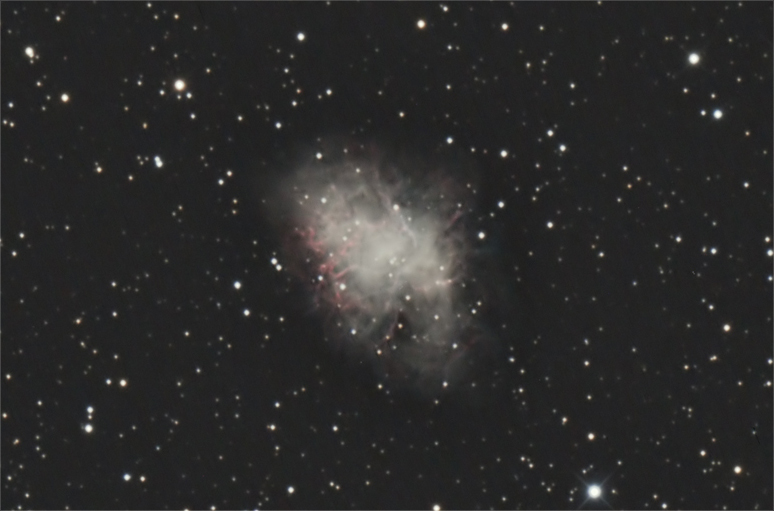
Crab Nebula, a supernova remnant in Taurus
November 2010
About M1
The Crab Nebula, M1 is the best known and brightest supernova in recorded history. Observed by Chinese Astronomers in 1054 AD, it was so bright as to be visible in the daytime. It has now expanded to a diameter of 10 LY and a neutron star (pulsar) has been identified as the remnant of the original star. It is located in the constellation of Taurus and is 6,000 LY distant from Earth.
November 8, 2010 · 8″ Astro-Tech RC, f/8 · Canon Digital Rebel 500D / Modified (Hutech) · 130 Minutes / 13x600s @ 800ASA · Orion StarShoot AutoGuider · Skyhawk Observatory, West Bend, WI · Photo by Rick Kazmierski

Lagoon Nebula, an emission nebula in Sagittarius
August 2021
About M8
The Lagoon Nebula (M8) and the young star cluster NGC 6530 (center left) are located in the constellation of Sagittarius, 5,000 LY from our solar system. This nebula is a huge cloud of gas and dust and the birth place of new stars. These young energetic stars ionize the surrounding Hydrogen gas, which causes it to emit light. Estimates vary, but the full extent of this nebula is well over 50 LY across.
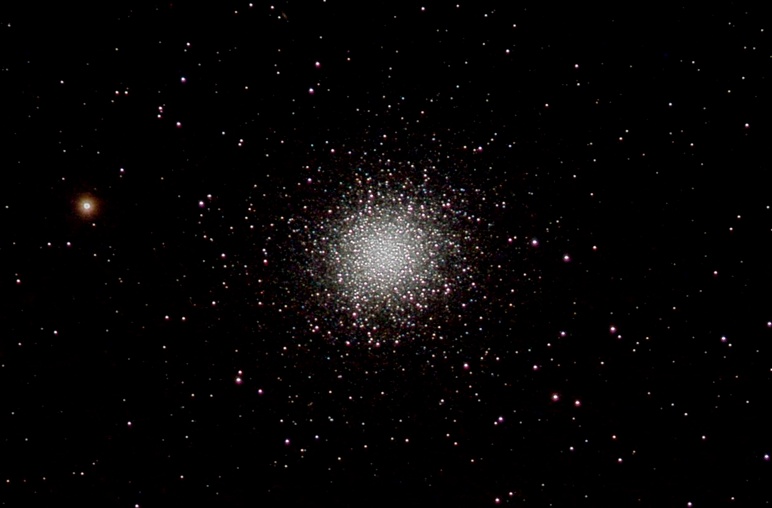
Great Hercules Cluster
July 2008
About M13
A Globular Cluster in the constellation Hercules, M13 is a distance of 20,000 LY from Earth. Also known as the Hercules Cluster, it contains 100,000 stars and is 150 LY across. Messier 13 is one of the most prominent Globular Clusters in the sky and is 12 billion years old.
July 23, 2008 · WO ZS 105mm f/7 Apo Refractor – Baader IR Filter · Canon Digital Rebel 300D / Modified (Hap Griffin) · 36 Minutes / 12x180s @ 800ASA · Manually guided on a 14″ Meade LX200 · Skyhawk Observatory, West Bend, WI · Photo by Rick Kazmierski

Great Hercules Cluster with the galaxy NGC 6207
About M13 & NGC 6207
A Globular Cluster in the constellation Hercules, M13 is a distance of 20,000 LY from Earth. Also known as the Hercules Cluster, it contains 100,000 stars and is 150 LY across. Messier 13 is one of the most prominent Globular Clusters in the sky and is 12 billion years old.
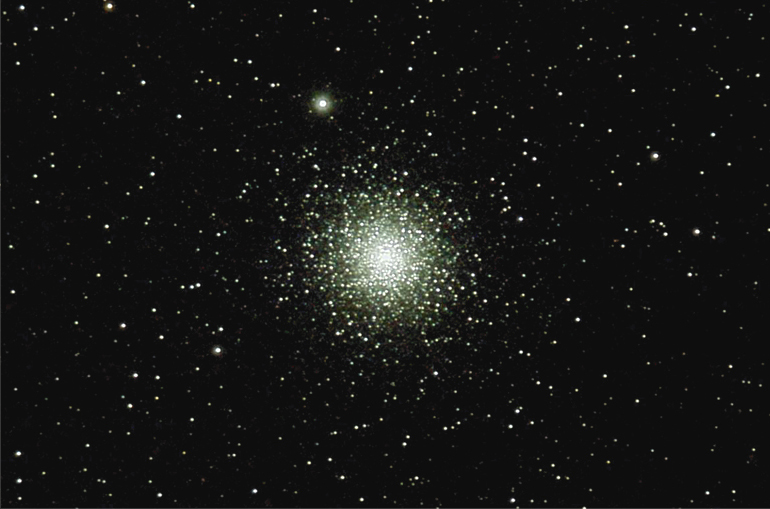
Globular star cluster in Pegasus
August 2008
About M15
Globular Cluster M15 resides in the constellation Pegasus at a distance of 34,000 LY from Earth. It contains 550,000 solar masses and is 120 LY across, making it one of the most centrally condensed clusters known. So dense, it is thought to contain a medium size black hole at its center.
August 9, 2008 · WO ZS 105mm f/7 Apo Refractor · Canon Digital Rebel 400D / Modified (Hap Griffin) · 36 Minutes / 12x180s @ 800ASA · Manually guided on a 14″ Meade LX200 · Skyhawk Observatory, West Bend, WI · Photo by Rick Kazmierski
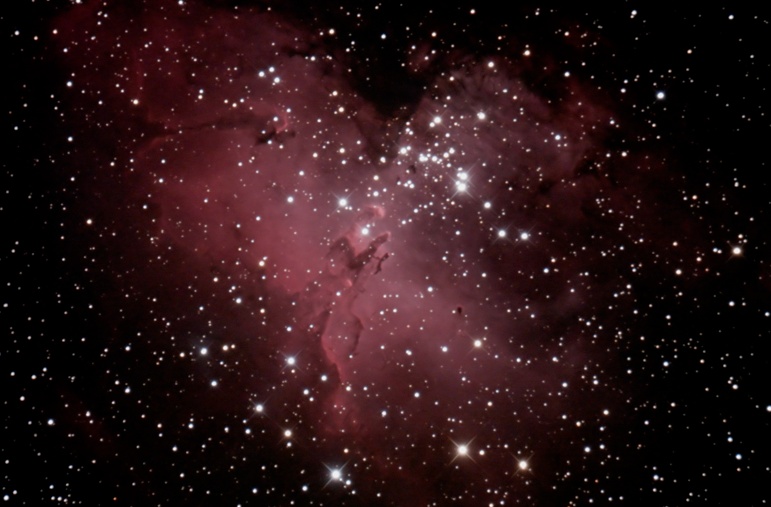
Eagle Nebula, an emission nebula in Serpens
June 2010
About M16
The Eagle Nebula, M16 and its associated nebula IC4703 are located in the constellation Serpens, 7,000 LY from our Solar System. Only 5 million years old, this young nebula is estimated to be 15 LY across. The three huge pillars of gas at the center of the image are active star forming regions.
June 1, 2010 · 8″ Astro-Tech RC, f/8 · Canon Digital Rebel 500D / Modified (Hutech) · 120 Minutes / 12x600s @ 800ASA · Orion StarShoot AutoGuider · Skyhawk Observatory, West Bend, WI · Photo by Rick Kazmierski

Eagle Nebula, an emission nebula in Serpens
June 2022
About M16
The Eagle Nebula, M16 and its associated nebula IC4703 are located in the constellation Serpens, 7,000 LY from our Solar System. Only 5 million years old, this young nebula is estimated to be 15 LY across. The three huge pillars of gas at the center of the image are active star forming regions.
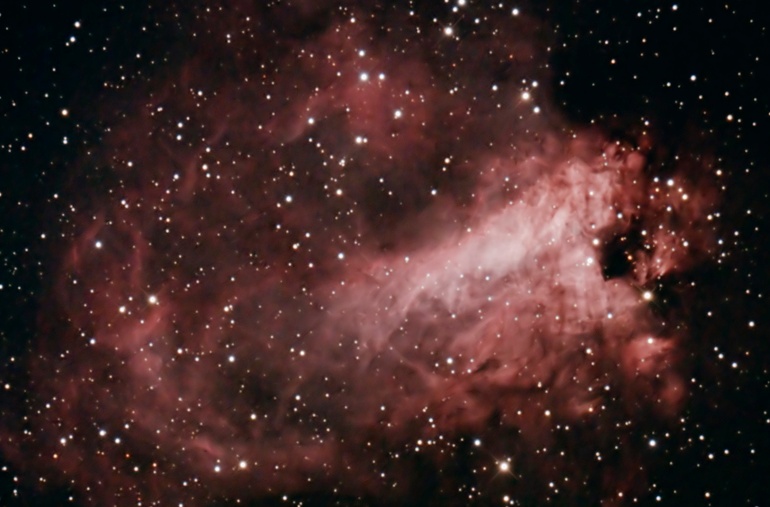
Omega Nebula, an emission nebula in Sagittarius
June 2010
About M17
The Omega Nebula (M17) is an emission nebula in the constellation Sagittarius, 5,500 LY from our solar system. Also known as the Swan Nebula, this large cloud of gas and dust is the birth place of new stars. These energetic stars ionize the surrounding Hydrogen gas, which causes it to emit light. Estimates suggest M17 is 50 LY across.
June 19, 2010 · 8″ Astro-Tech RC, f/8 · Canon Digital Rebel 500D / Modified (Hutech) · 230 Minutes / 23x600s @ 800ASA · Orion StarShoot AutoGuider · Skyhawk Observatory, West Bend, WI · Photo by Rick Kazmierski

Omega Nebula, an emission nebula in Sagittarius
July 2021
About M17
The Omega Nebula (M17) is an emission nebula in the constellation Sagittarius, 5,500 LY from our solar system. Also known as the Swan Nebula, this large cloud of gas and dust is the birth place of new stars. These energetic stars ionize the surrounding Hydrogen gas, which causes it to emit light. Estimates suggest M17 is 50 LY across.
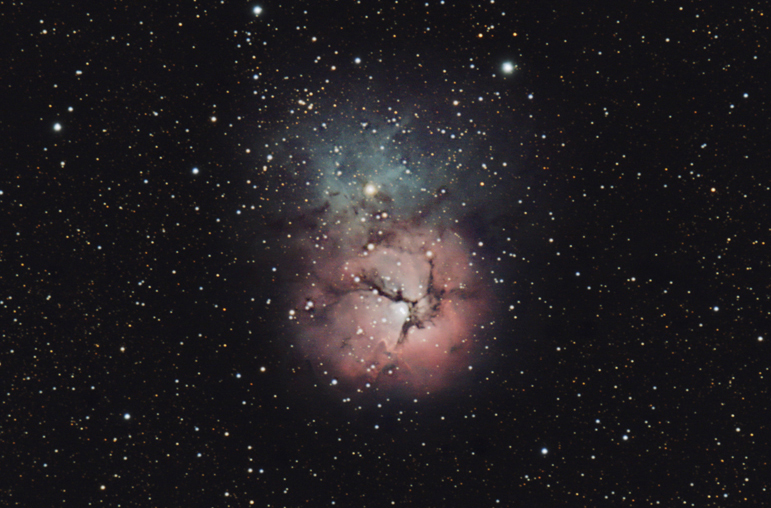
Trifid Nebula, in Sagittarius
August 2008
About M20
The Trifid Nebula (M20) is located in the constellation of Sagittarius, 3,000 LY from Earth. Noted for its three lobed appearance, it is both a red emission nebula and a blue reflection nebula. It emits light due to young hot stars at its center.
August 6, 2008 · WO ZS 105mm f/7 Apo Refractor · Canon Digital Rebel 400D / Modified (Hap Griffin) · 115 Minutes / 23x300s @ 800ASA · Manually guided on a 14″ Meade LX200 · Skyhawk Observatory, West Bend, WI · Photo by Rick Kazmierski
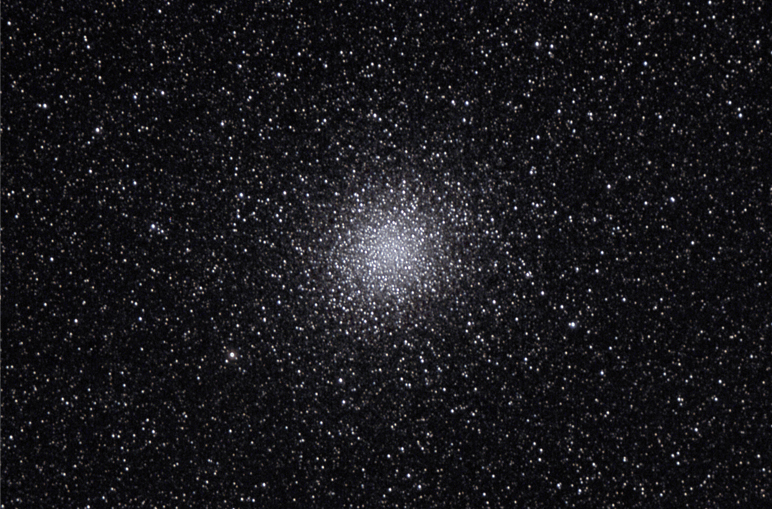
Globular star cluster in Sagittarius
August 2008
About M22
Globular Cluster M22 resides in the constellation Sagittarius at a distance of 10,400 LY from Earth, making it one of the nearest objects of its type. It contains approximately 70,000 solar masses and is estimated to be 88 LY across. It is one of the brightest Globular Clusters, brighter than M13.
August 31, 2008 · WO ZS 105mm f/7 Apo Refractor · Canon Digital Rebel 400D / Modified (Hap Griffin) · 39 Minutes / 18x180s @ 800ASA · Manually guided on a 14″ Meade LX200 · Skyhawk Observatory, West Bend, WI · Photo by Rick Kazmierski
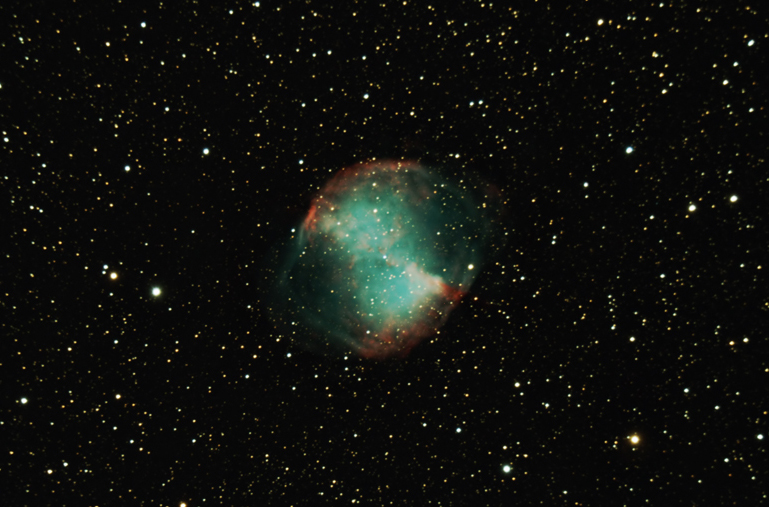
Dumbbell Nebula, a planetary nebula in Vulpecula
August 2009
About M27
The Dumbbell Nebula (M27) is a planetary nebula in the constellation of Vulpecula, about 1,200 LY from Earth. The central star which generated this nebula was once a sun much like our own. Approximately 3,500 years ago it exhausted its nuclear fuel and in the process, shed its outer gaseous layers into space. In the process, any close orbiting planets would have been vaporized.
August 18, 2009 · 14″ Meade LX200 f/6.3 · Canon Digital Rebel 500D / Modified (Hutech) · 80 Minutes / 20x240s @ 800ASA · Orion StarShoot AutoGuider · Skyhawk Observatory, West Bend, WI · Photo by Rick Kazmierski
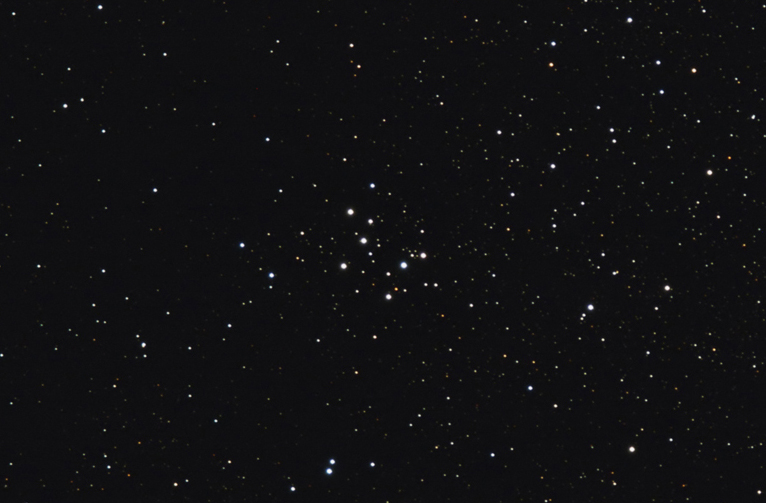
Open star cluster in Cygnus
August 2008
About M29
M29 is an inconspicuous Open Cluster in the constellation Cygnus. Due to obstructing interstellar gas and dust around the cluster, estimates of member numbers are difficult. Estimates range from 20 to 40 stars. M29 lies at a distance of 7,000 LY and is approximately 10 million years old.
August 5, 2008 · WO ZS 105mm f/7 Apo Refractor · Canon Digital Rebel 400D / Modified (Hap Griffin) · 18 Minutes / 6x180s @ 800ASA · Manually guided on a 14″ Meade LX200 · Skyhawk Observatory, West Bend, WI · Photo by Rick Kazmierski

Andromeda Galaxy
August 2006
About M31
The Andromeda Galaxy M31 is the largest member of our Local Group of galaxies. It is nearly 2.5 million LY away, extends 200,000 LY across, and boasts a total of 300 billion stars. Recent measurements indicate that Andromeda will collide with our Milky Way Galaxy sometime in the distant future. Companion galaxies M32 and M110 are prominent in the image.
August 20, 2006 · Orion 80mm Apo Refractor – f/7.5 – Baader IR Filter · Canon Digital Rebel 300D / Modified (Hap Griffin) · 80 Minutes / 16x300s @ 800ASA · Manually guided on a 14″ Meade LX200 · Skyhawk Observatory, West Bend, WI · Photo by Rick Kazmierski
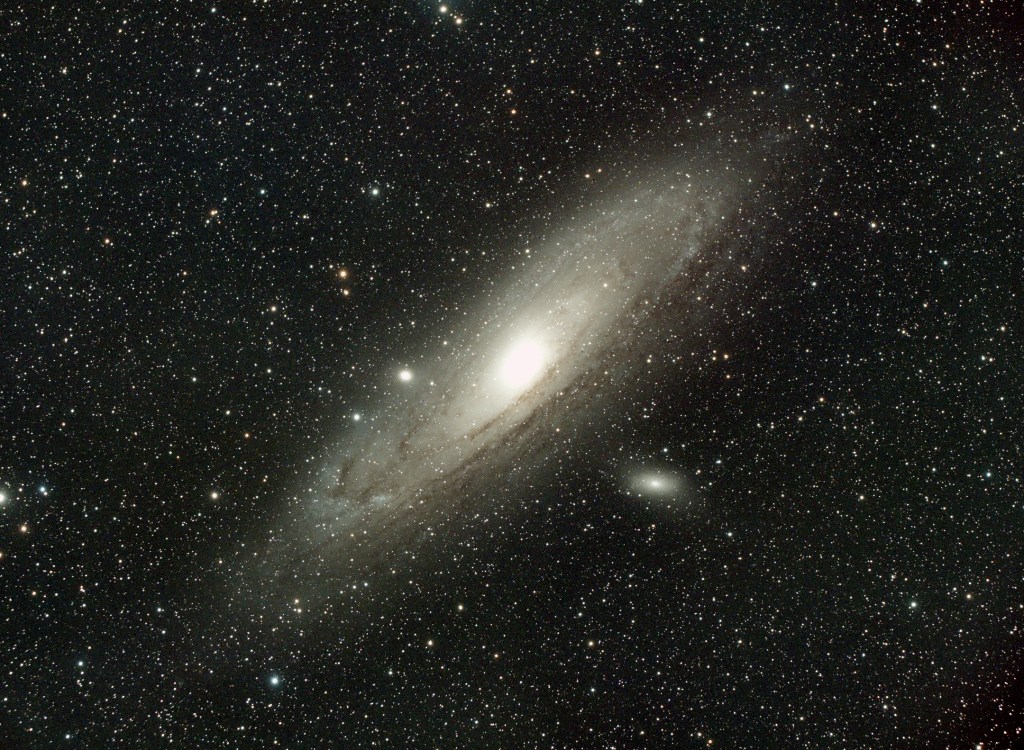
Andromeda Galaxy
August 2022
About M31
The Andromeda Galaxy M31 is the largest member of our Local Group of galaxies. It is nearly 2.5 million LY away, extends 200,000 LY across, and boasts a total of 300 billion stars. Recent measurements indicate that Andromeda will collide with our Milky Way Galaxy sometime in the distant future. Companion galaxies M32 and M110 are prominent in the image.
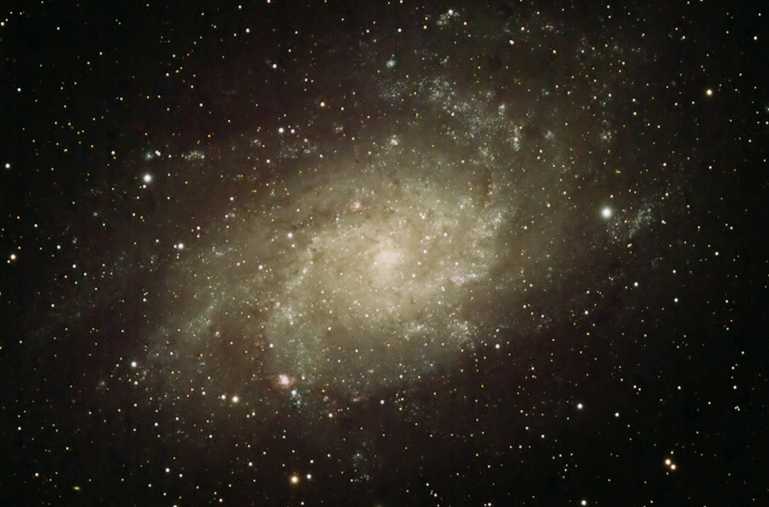
Triangulum Galaxy
September 2008
About M33
The Triangulum Galaxy (M33) is a member of our local group of galaxies 3 million LY from our Milky Way Galaxy. It is about 1/2 the size of our galaxy and contains 40 billion stars. Lying only 750,000 LY from the Andromeda Galaxy, it is believed to be a gravitational satellite of its neighbor.
September 9, 2008 · WO ZS 105mm f/7 Apo Refractor · Canon Digital Rebel 400D / Modified (Hap Griffin) · 210 Minutes / 42x300s @ 800ASA · Manually guided on a 14″ Meade LX200 · Skyhawk Observatory, West Bend, WI · Photo by Rick Kazmierski
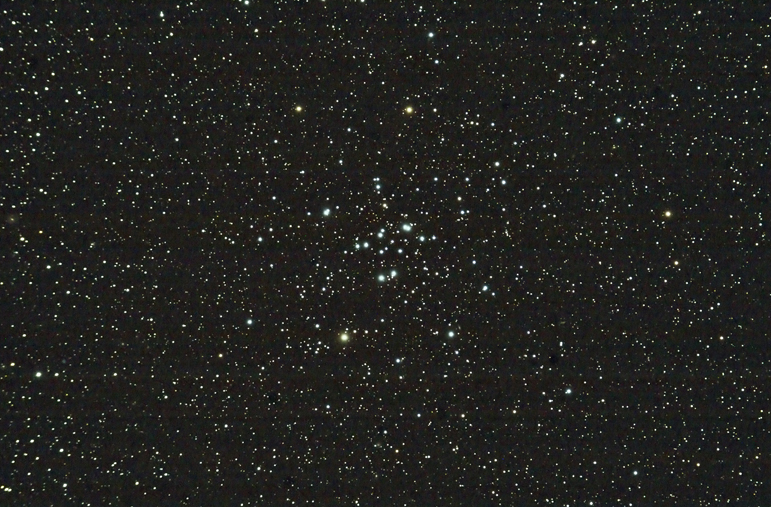
Open star cluster in Perseus
October 2008
About M34
A large open cluster in the constellation Perseus, M34 contains about 100 stars and is estimated to be 190 million years old, making it a middle aged cluster. Observations indicate this cluster to be 1,400 LY distant and approximately 14 LY across.
October 4, 2008 · WO ZS 105mm f/7 Apo Refractor · Canon Digital Rebel 400D / Modified (Hap Griffin) · 18 Minutes / 6x180s @ 800ASA · Manually guided on a 14″ Meade LX200 · Skyhawk Observatory, West Bend, WI · Photo by Rick Kazmierski
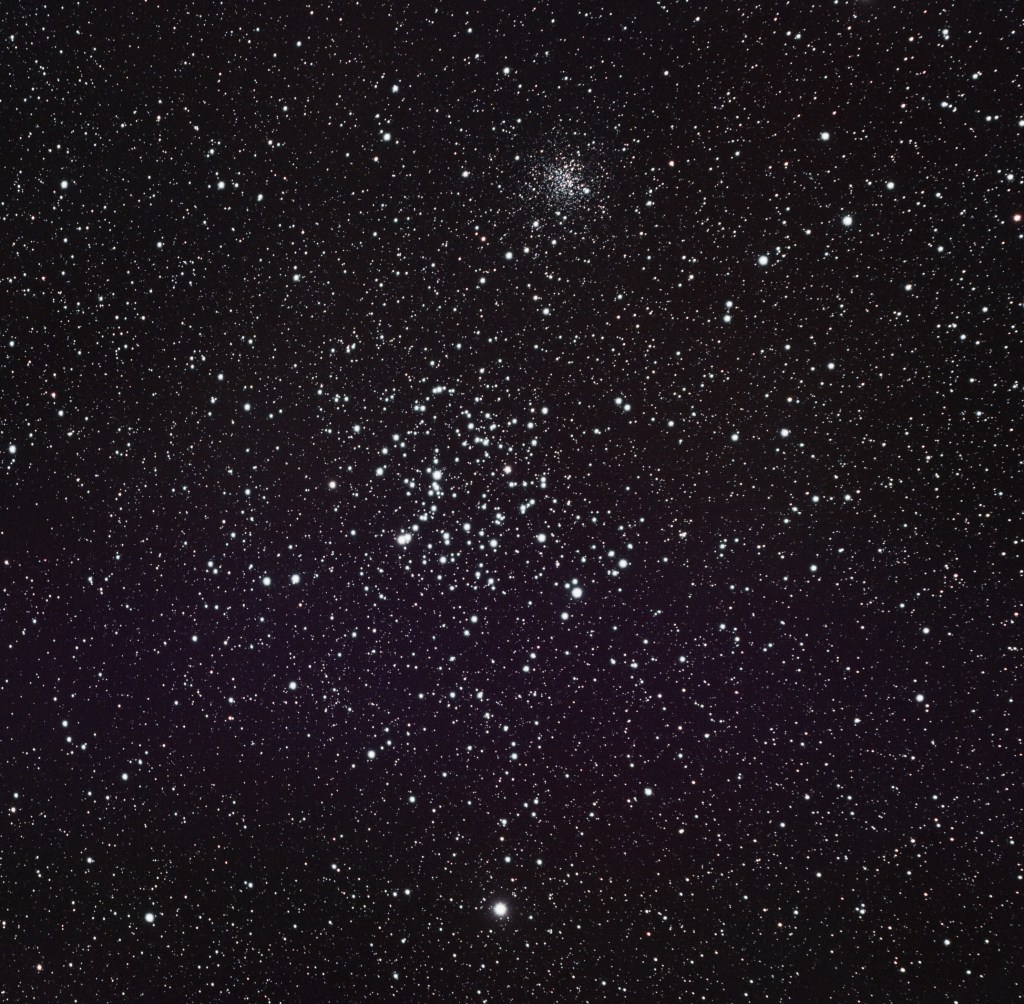
Two open star clusters in Gemini
March 2022
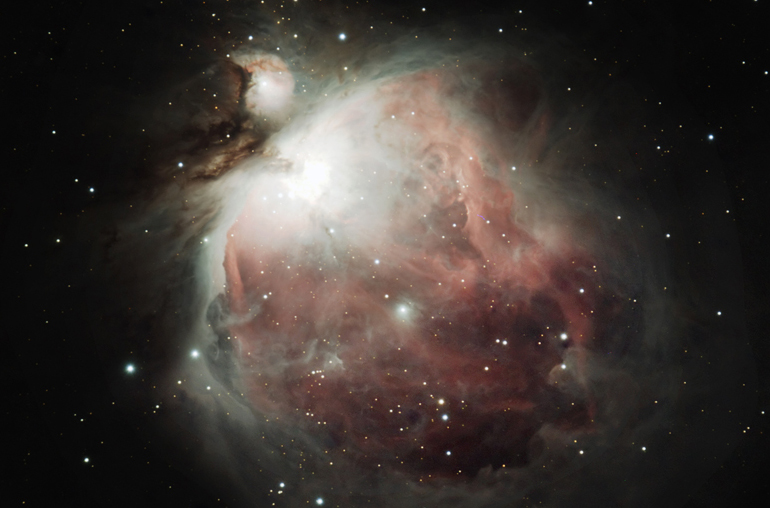
Orion Nebula
November 2008
About M42
The Orion Nebula (M42) is one of the brightest and closest star forming regions to our Solar System, lying about 1,500 LY away in the constellation Orion. The above image also contains M43, the smaller flame shaped cloud in the upper left. The Orion Nebula is part of the larger star forming cloud known as the Orion Molecular Cloud Complex, which spans several hundred light years.
November 20, 2008 · WO 105mm f/7 Apo Refractor · Canon Digital Rebel 400D / Modified (Hap Griffin) · 72 Minutes / 24x180s @ 800ASA · Manually guided on a 14″ Meade LX200 · Skyhawk Observatory, West Bend, WI · Photo by Rick Kazmierski
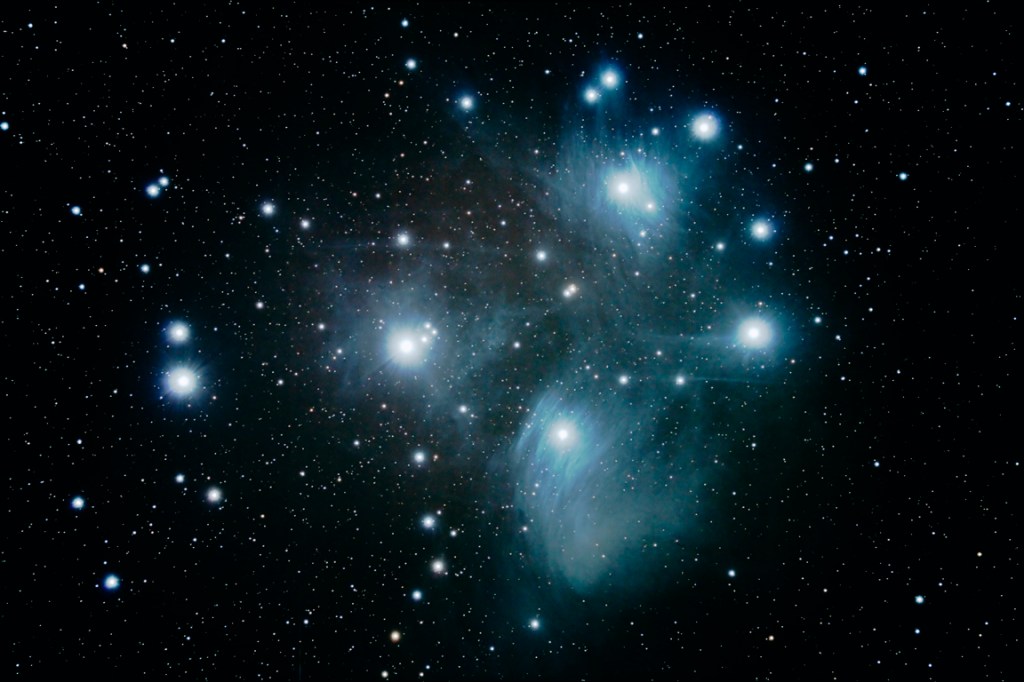
Pleiades, an open star cluster in Taurus
January 2010
About M45
The Pleiades Star Cluster (M45) lies nearly 400 LY from Earth in the constellation of Taurus. At an estimated age of 100 million years, it is an older cluster whose stars will disperse in the next 300 million years. A reflection nebula by nature, the gas and dust visible in this image shines by the reflected light of the bright stars in the vicinity. This gas is not the cloud from which these stars originally formed, but an unrelated gas cloud through which the cluster is passing. The Pleiades contains an estimated 500 stars. Known as the Seven Sisters to the Greeks, the brightest seven stars in the cluster were used by some cultures as a test of eyesight.
January 5, 2010 · WO 105mm f/7 Apo Refractor – AT Field Flattener · Canon Digital Rebel 500D / Modified (Hutech) · 120 Minutes / 12x600s @ 1600ASA · Orion StarShoot AutoGuider · Skyhawk Observatory, West Bend, WI · Photo by Rick Kazmierski

Whirlpool Galaxy, in Canes Venatici
January 2010
About M51
The Whirlpool Galaxy (M51) and its companion are a beautiful example of interacting galaxies. In fact, the spiral structure of M51 is the direct result of their gravitational encounter. The Whirlpool galaxy is a distance of 23 million LY from our solar system and approximately 1/2 the size of our Milky Way Galaxy. It is the first galaxy in which spiral structure was identified. Located in the constellation Canes Venatici, it is the largest member of a small group of galaxies which includes M63, the Sunflower Galaxy.
January 17, 2010 · 14″ Meade LX200 f/6.3 · Canon Digital Rebel 500D / Modified (Hutech) · 80 Minutes / 16x300s @ 800ASA · Orion StarShoot AutoGuider · Skyhawk Observatory, West Bend, WI · Photo by Rick Kazmierski
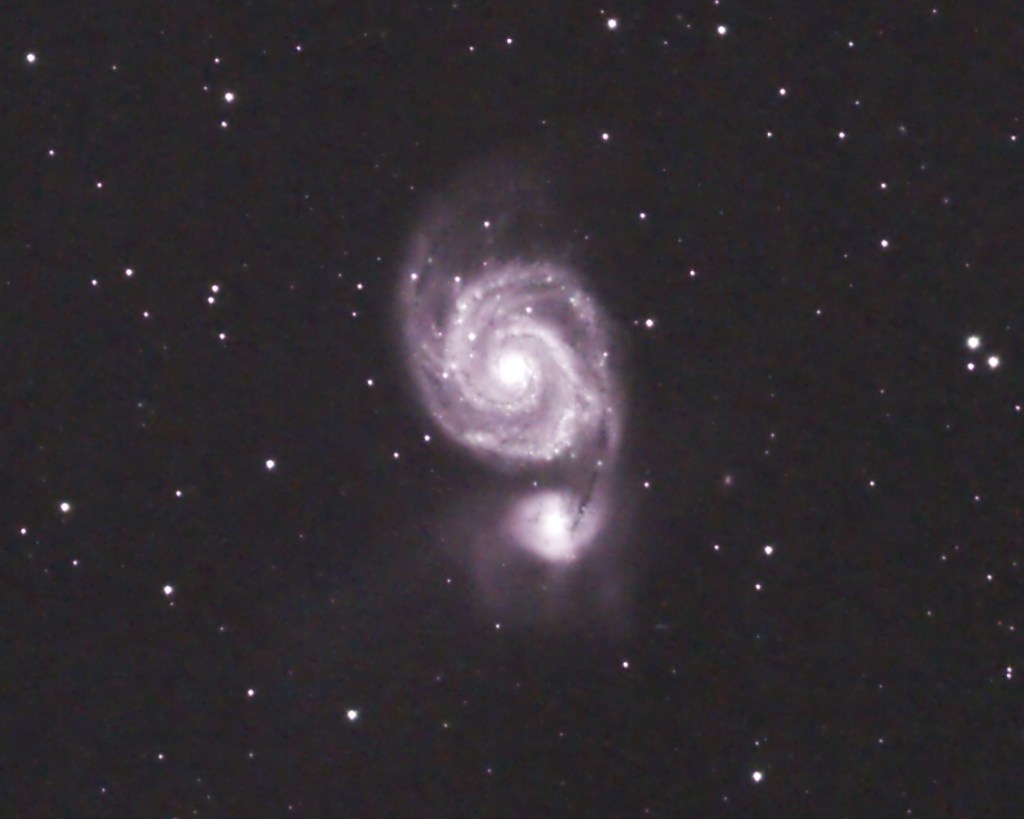
Whirlpool Galaxy, in Canes Venatici
May 2021
About M51
The Whirlpool Galaxy (M51) and its companion are a beautiful example of interacting galaxies. In fact, the spiral structure of M51 is the direct result of their gravitational encounter. The Whirlpool galaxy is a distance of 23 million LY from our solar system and approximately 1/2 the size of our Milky Way Galaxy. It is the first galaxy in which spiral structure was identified. Located in the constellation Canes Venatici, it is the largest member of a small group of galaxies which includes M63, the Sunflower Galaxy.
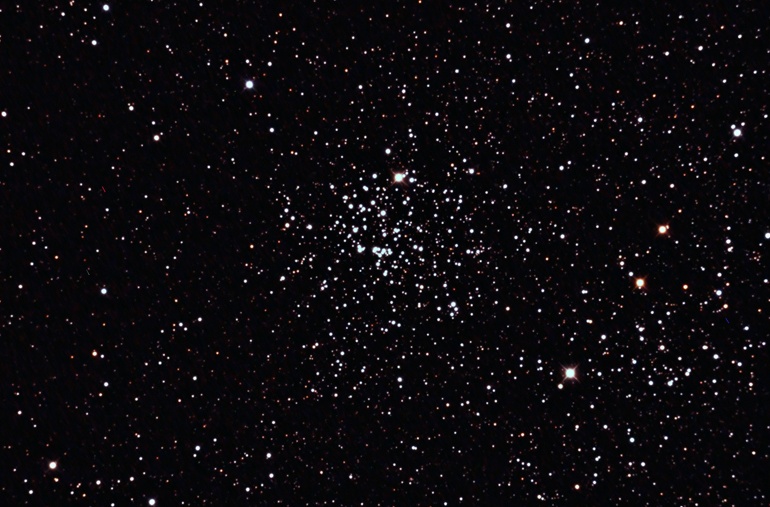
Open star cluster in Cassiopeia
November 2010
About M52
Messier 52, an open star cluster in Cassiopeia.
November 8, 2010 · 8″ Astro-Tech RC, f/8 · Canon Digital Rebel 500D / Modified (Hutech) · 105 Minutes / 21x300s @ 800ASA · Orion StarShoot AutoGuider · Skyhawk Observatory, West Bend, WI · Photo by Rick Kazmierski
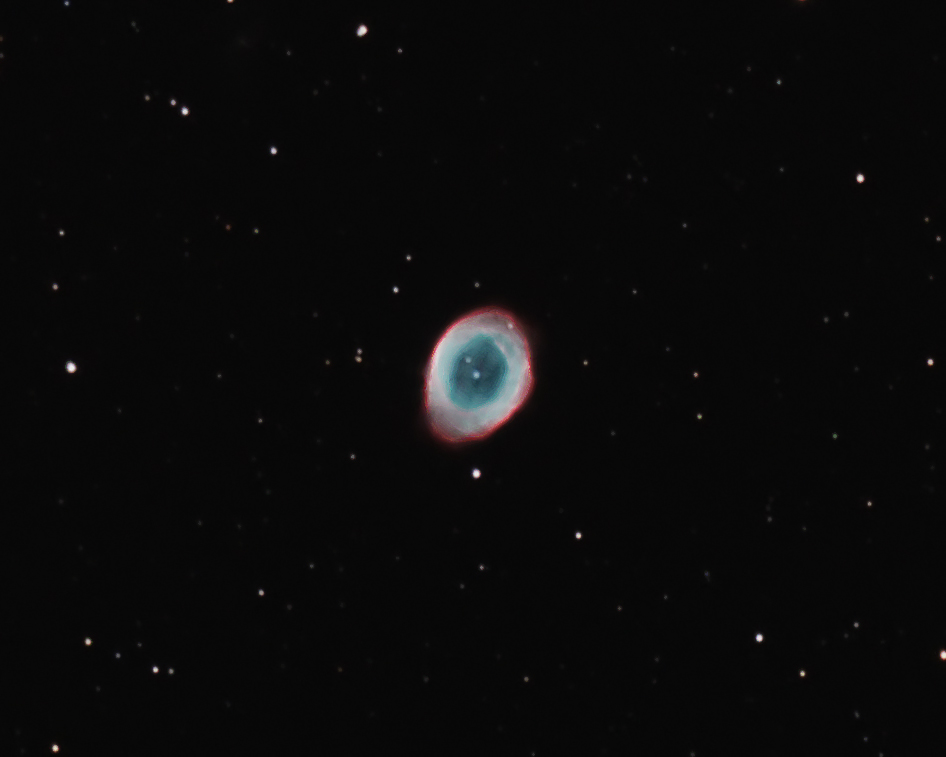
Ring Nebula, a planetary nebula in Lyra
June 2010
About M57
The Ring Nebula M57 lies in the constellation Lyra at an estimated 2,300 LY from Earth. It is considered the prototype of Planetary Nebula. Its bright central star is a White Dwarf which shines at magnitude fifteen (faintly visible in the above image) with a temperature of 100,000K. It will slowly cool over the next billion years, eventually becoming a Black Dwarf. The bright gaseous ring is the result of this star’s outer layers being blown into space at the end of its Mira-like phase.
June 19, 2010 · 8″ Astro-Tech RC, f/8 · Canon Digital Rebel 500D / Modified (Hutech) · 24 Minutes / 8x240s @ 800ASA · Orion StarShoot AutoGuider · Skyhawk Observatory, West Bend, WI · Photo by Rick Kazmierski

Sunflower Galaxy, in Canes Venatici
April 2007
About M63
The Sunflower Galaxy (M63) is a spiral galaxy located in Canes Venatici, 37 million LY from our solar system. It gets its colorful name from the motley appearance of its outer structure. It is believed to be a gravitational member of the M51 Group of galaxies.
Sunflower Galaxy (small copy only)
March 2011
About M63
The Sunflower Galaxy (M63) is a spiral galaxy located in Canes Venatici, 37 million LY from our solar system. It gets its colorful name from the motley appearance of its outer structure. It is believed to be a gravitational member of the M51 Group of galaxies.
March 25, 2011 · 8″ Astro-Tech RC · Canon Digital Rebel 500D / Modified (Hutech) · 140 Minutes / 14x600s @ 800ASA · Orion StarShoot AutoGuider · Skyhawk Observatory, West Bend, WI · Photo by Rick Kazmierski

Black Eye Galaxy, in Coma Berenices
April 2007
About M64
The Blackeye Galaxy (M64) is a spiral galaxy located in Coma Berenices, an estimated 19 million LY from Earth. Also referred to as the Sleeping Beauty Galaxy, its prominent feature is the light absorbing dust lane near its center.
Black Eye Galaxy (small copy only)
March 2011
About M64
The Blackeye Galaxy (M64) is a spiral galaxy located in Coma Berenices, an estimated 19 million LY from Earth. Also referred to as the Sleeping Beauty Galaxy, its prominent feature is the light absorbing dust lane near its center.
March 28, 2011 · 8″ Astro-Tech RC · Canon Digital Rebel 500D / Modified (Hutech) · 130 Minutes / 13x600s @ 800ASA · Orion StarShoot AutoGuider · Skyhawk Observatory, West Bend, WI · Photo by Rick Kazmierski

Spiral galaxy in Leo
March 2022
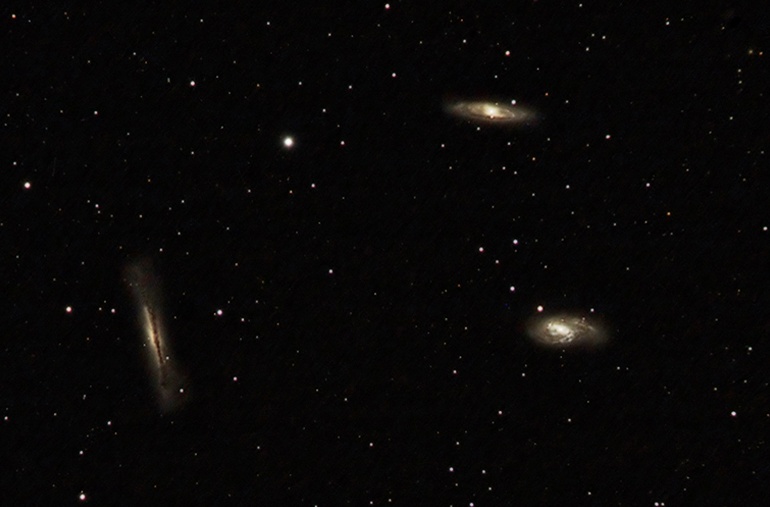
M65, M66 and NGC 3628, three galaxies in Leo
February 2007
About Leo Triplet
M65 (upper right), M66 (lower right), and NGC3628 (lower left) are spiral galaxies comprising the group known as the Leo Triplet. Located in the constellation of Leo, they lie 35 million LY from Earth. The twisted appearance of M66 indicates external gravitational disturbance in the past, probably from neighboring galaxies. M65 is 60,000 LY across its long axis, while M66 is only 50,000 LY across.
February 21, 2007 · WO ZS 105mm f/7 Apo Refractor – Baader IR Filter · Canon Digital Rebel 300D / Modified (Hap Griffin) · 60 Minutes / 12x300s @ 800ASA · Manually guided on a 14″ Meade LX200 · Skyhawk Observatory, West Bend, WI · Photo by Rick Kazmierski

Spiral galaxy in Pisces
November 2010
About M74
Messier 74, a spiral galaxy in Pisces.
November 2, 2010 · 8″ Astro-Tech RC, f/8 · Canon Digital Rebel 500D / Modified (Hutech) · 150 Minutes / 15x600s @ 800ASA · Orion StarShoot AutoGuider · Skyhawk Observatory, West Bend, WI · Photo by Rick Kazmierski

Reflection nebula in Orion
February 2007
About M78
The bright reflection nebula M78 is located in the constellation of Orion 1,600 LY from Earth. M78 is part of the larger star forming cloud known as the Orion Molecular Cloud Complex, which spans several hundred light years.
February 2007 · WO ZS 105mm f/7 Apo Refractor – Baader IR Filter · Canon Digital Rebel 300D / Modified (Hap Griffin) · 105 Minutes / 21x300s @ 800ASA · Manually guided on a 14″ Meade LX200 · Skyhawk Observatory, West Bend, WI · Photo by Rick Kazmierski

Bode’s Galaxy, in Ursa Major
April 2007
About M81
M81 is a beautiful spiral galaxy located in the constellation of Ursa Major at a distance of 12 million LY. It is only 150,000 LY distant from its neighbor M82. These two galaxies are coming off a close encounter which has left M82 badly deformed. Both are members of the small group of galaxies known as the M81 Group.
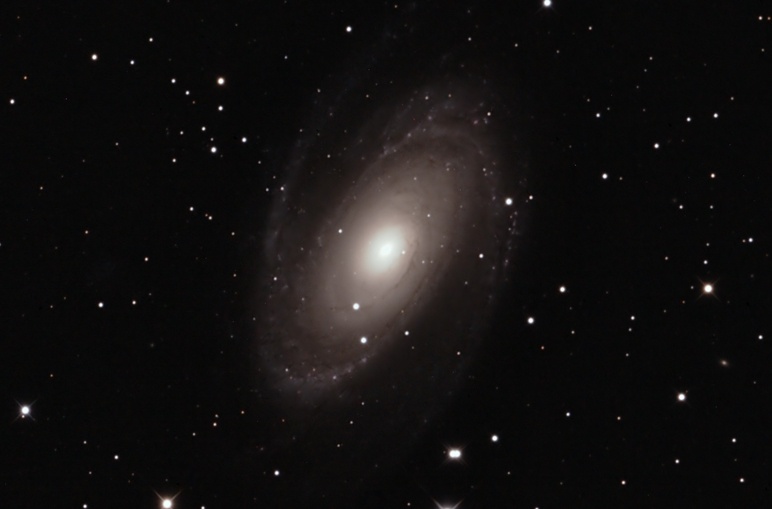
Bode’s Galaxy, in Ursa Major
January 2011
About M81
M81 is a beautiful spiral galaxy located in the constellation of Ursa Major at a distance of 12 million LY. It is only 150,000 LY distant from its neighbor M82. These two galaxies are coming off a close encounter which has left M82 badly deformed. Both are members of the small group of galaxies known as the M81 Group.
January 8, 2011 · 8″ Astro-Tech RC, f/8 · Canon Digital Rebel 500D / Modified (Hutech) · 140 Minutes / 14x600s @ 800ASA · Orion StarShoot AutoGuider · Skyhawk Observatory, West Bend, WI · Photo by Rick Kazmierski

Bode’s Galaxy and the Cigar Galaxy, in Ursa Major
May 2021
About M81 & M82
M81 is a beautiful spiral galaxy located in the constellation of Ursa Major at a distance of 12 million LY. It is only 150,000 LY distant from its neighbor M82. These two galaxies are coming off a close encounter which has left M82 badly deformed. Both are members of the small group of galaxies known as the M81 Group.

Cigar Galaxy, in Ursa Major
April 2010
About M82
A peculiar galaxy in Ursa Major, M82 lies approximately 12 million LY from Earth. It is involved in heavy star formation and a prototype of the class of starburst galaxies. The core of this galaxy has suffered from a recent encounter with its neighbor M81 about 50 to 100 million years ago. This interaction generated the increased star formation and is largely the cause of M82’s peculiar shape.
April 11, 2010 · 10″ Astro-Tech RC · Canon Digital Rebel 500D / Modified (Hutech) · 160 Minutes / 32x300s @ 800ASA · Orion StarShoot AutoGuider · Skyhawk Observatory, West Bend, WI · Photo by Rick Kazmierski
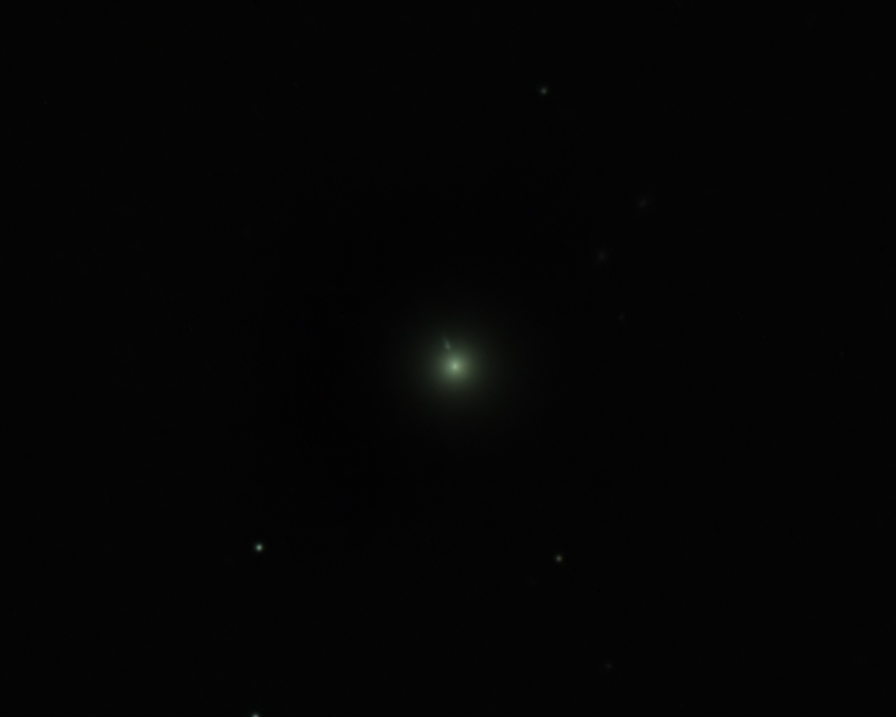
Giant elliptical galaxy in Virgo
March 2010
About M87
M87 is a supergiant elliptical galaxy located in the constellation of Virgo. It is the largest and brightest of the northern Virgo cluster of galaxies and is 55 million LY from Earth. M87 spans 120,000 LY and has a mass of several trillion suns. It has an active nucleus which is ejecting a spectacular jet of material 7,000 LY long. This jet is seen in the above image at the 11:00 position.
March 21, 2010 · 8″ Astro-Tech RC · Canon Digital Rebel 500D / Modified (Hutech) · 22 Minutes / 11x120s @ 800ASA · Orion StarShoot AutoGuider · Skyhawk Observatory, West Bend, WI · Photo by Rick Kazmierski
Spiral galaxy in Coma Berenices (small copy only)
March 2011
About M88
March 30, 2011 · 8″ Astro-Tech RC · Canon Digital Rebel 500D / Modified (Hutech) · 120 Minutes / 12x600s @ 800ASA · Orion StarShoot AutoGuider · Skyhawk Observatory, West Bend, WI · Photo by Rick Kazmierski
Globular star cluster in Hercules (small copy only)
May 2010
About M92
Messier 92, a globular star cluster in Hercules.
May 24, 2010 · 8″ Astro-Tech RC, f/8 · Canon Digital Rebel 500D / Modified (Hutech) · 80 Minutes / 20x240s @ 800ASA · Orion StarShoot AutoGuider · Skyhawk Observatory, West Bend, WI · Photo by Rick Kazmierski
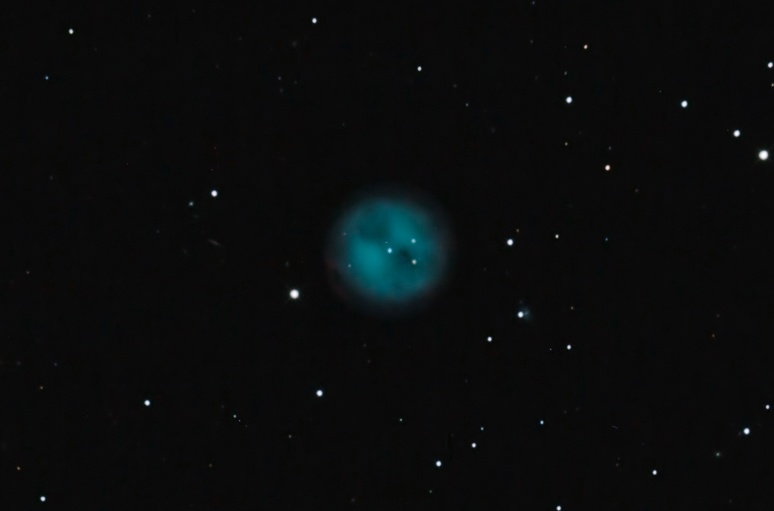
Owl Nebula, a planetary nebula in Ursa Major
March 2010
About M97
Regarded as one of the more complex planetary nebula, the Owl Nebula (M97) gets its name due to the two dark orbs in the nebula which give it the appearance of owl-like eyes. It lies in the constellation of Ursa Major, probably several thousand LY distant. The 16th magnitude central star has about 0.7 solar masses and the nebula itself about 0.15 solar masses. In the background of the image, there are a number of distant galaxies to the left of center and a much smaller gaseous nebula lower right.
March 21, 2010 · 8″ Astro-Tech RC · Canon Digital Rebel 500D / Modified (Hutech) · 80 Minutes / 16x300s @ 800ASA · Orion StarShoot AutoGuider · Skyhawk Observatory, West Bend, WI · Photo by Rick Kazmierski

Pinwheel Galaxy, in Ursa Major
May 2009
About M101
M101 (Pinwheel Galaxy) is a huge spiral galaxy in the constellation Ursa Major. It stretches 170,000 LY in diameter, making it twice the size of our Milky Way Galaxy. From our vantage point, it is viewed face on and reveals a fascinating amount of detail in its spiral arm structure. M101 contains about 33 billion suns and lies at a distance of 25 million LY from Earth.
May 2009 · WO ZS 105mm f/7 Apo Refractor · Canon Digital Rebel 400D / Modified (Hap Griffin) · 140 Minutes / 28x300s @ 1600ASA · Manually guided on a 14″ Meade LX200 · Skyhawk Observatory, West Bend, WI · Photo by Rick Kazmierski
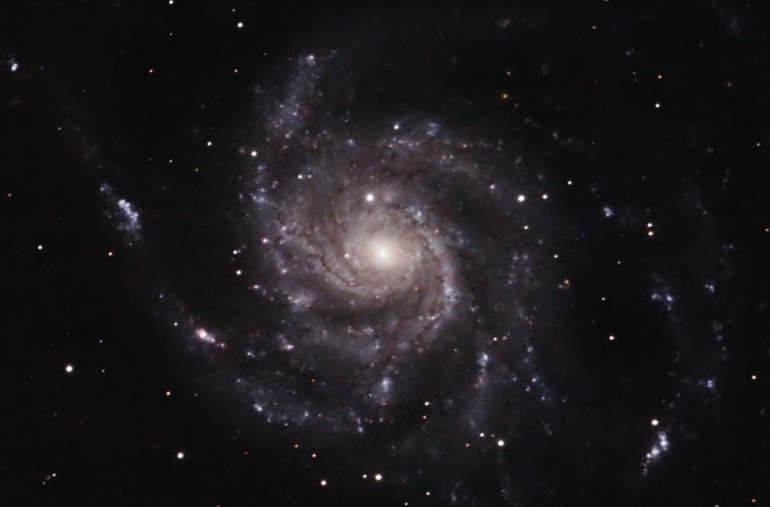
Pinwheel Galaxy, in Ursa Major
March 2011
About M101
M101 (Pinwheel Galaxy) is a huge spiral galaxy in the constellation Ursa Major. It stretches 170,000 LY in diameter, making it twice the size of our Milky Way Galaxy. M101 contains about 33 billion suns and lies at a distance of 25 million LY from Earth.
March 1, 2011 · 8″ Astro-Tech RC, f/8 · Canon Digital Rebel 500D / Modified (Hutech) · 160 Minutes / 16x600s @ 800ASA · Orion StarShoot AutoGuider · Skyhawk Observatory, West Bend, WI · Photo by Rick Kazmierski

Open star cluster in Cassiopeia
October 2008
About M103
M103 is a loose open cluster in the constellation Cassiopeia. Although a poor telescope object, it is easily identified in binoculars. This cluster has approximately 50 members and is an estimated 9 million years old. Observation suggests a distance of 8,000 LY and a diameter of 15 LY. A beautiful red giant star is obvious in the above photograph.
October 29, 2008 · WO ZS 105mm f/7 Apo Refractor · Canon Digital Rebel 400D / Modified (Hap Griffin) · 39 Minutes / 13x180s @ 800ASA · Manually guided on a 14″ Meade LX200 · Skyhawk Observatory, West Bend, WI · Photo by Rick Kazmierski
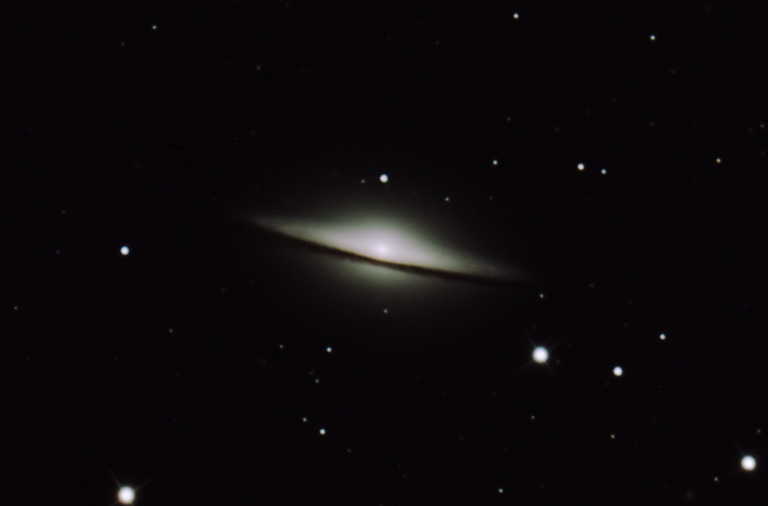
Sombrero Galaxy, in Virgo
March 2010
About M104
The Sombrero Galaxy (M104) is located in the constellation of Virgo, at a distance of 28 million LY from Earth. This spiral galaxy is viewed nearly edge-on and displays a pronounced central band of obscuring gas and dust. It is one of the brightest members of the Virgo Cluster of galaxies.
March 21, 2010 · 8″ Astro-Tech RC · Canon Digital Rebel 500D / Modified (Hutech) · 80 Minutes / 8x600s @ 800ASA · Orion StarShoot AutoGuider · Skyhawk Observatory, West Bend, WI · Photo by Rick Kazmierski
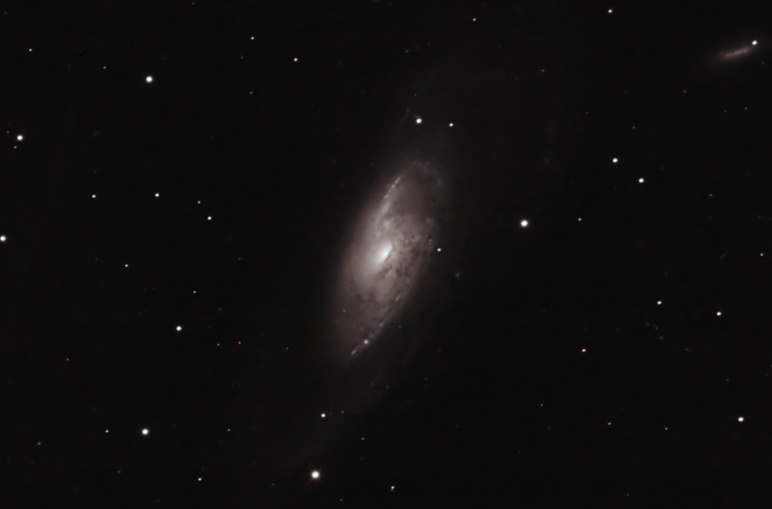
Spiral galaxy in Canes Venatici
March 2011
About M106
M106 is a spiral galaxy in the constellation of Canes Venatici at an estimated distance of 25 million LY from Earth. It is an x-ray source and is suspected to contain a super massive blackhole of up to 36 million solar masses. It is often listed as a Seyfert Galaxy.
March 1, 2011 · 8″ Astro-Tech RC, f/8 · Canon Digital Rebel 500D / Modified (Hutech) · 130 Minutes / 13x600s @ 800ASA · Orion StarShoot AutoGuider · Skyhawk Observatory, West Bend, WI · Photo by Rick Kazmierski
NGC Catalog
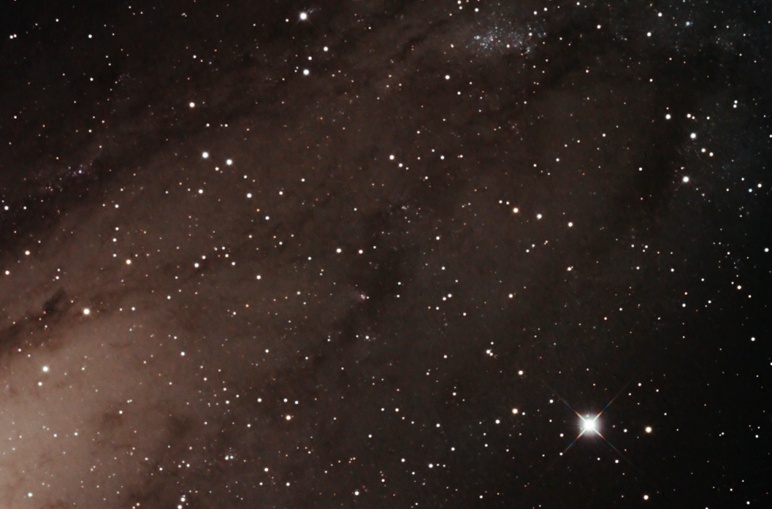
Bright star cloud within the Andromeda Galaxy
November 2010
About NGC 206
NGC206 is a bright starcloud in the outer reaches of the Andromeda Galaxy. Although it lies 2 million LY away, it is bright enough for Herschel to have listed it separately in his catalog. It can be seen right of center in the upper portion of this image.
November 9, 2010 · 8″ Astro-Tech RC, f/8 · Canon Digital Rebel 500D / Modified (Hutech) · 110 Minutes / 11x600s @ 800ASA · Orion StarShoot AutoGuider · Skyhawk Observatory, West Bend, WI · Photo by Rick Kazmierski
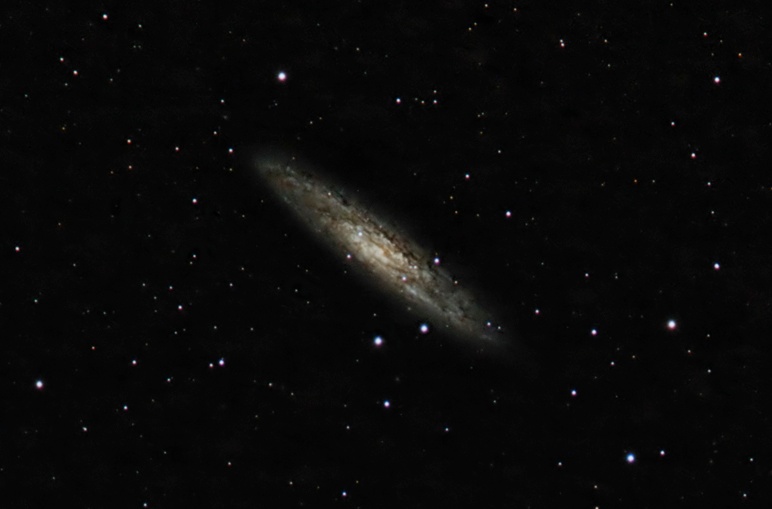
Sculptor Galaxy
November 2007
About NGC 253
NGC253 is located in the constellation of Sculptor and is the brightest member of a small group of galaxies known as the Sculptor Group. Nearly 10 million LY from Earth, the Sculptor Group is considered the closest independent group of galaxies to our own Local Group. NGC 253 is active in star formation and has been dubbed by some the Starburst Galaxy.
November 13, 2007 · WO ZS 105mm f/7 Apo Refractor – Baader IR Filter · Canon Digital Rebel 300D / Modified (Hap Griffin) · 115 Minutes / 23x300s @ 800ASA · Manually guided on a 14″ Meade LX200 · Skyhawk Observatory, West Bend, WI · Photo by Rick Kazmierski

Pac-Man Nebula, in Cassiopeia
October 2008
About NGC 281
The emission nebula NGC281 (PacMan nebula) is located in the constellation Cassiopeia and is associated with the open star cluster IC1590. It is located in the Perseus Spiral Arm and lies approximately 9,500 LY from Earth.
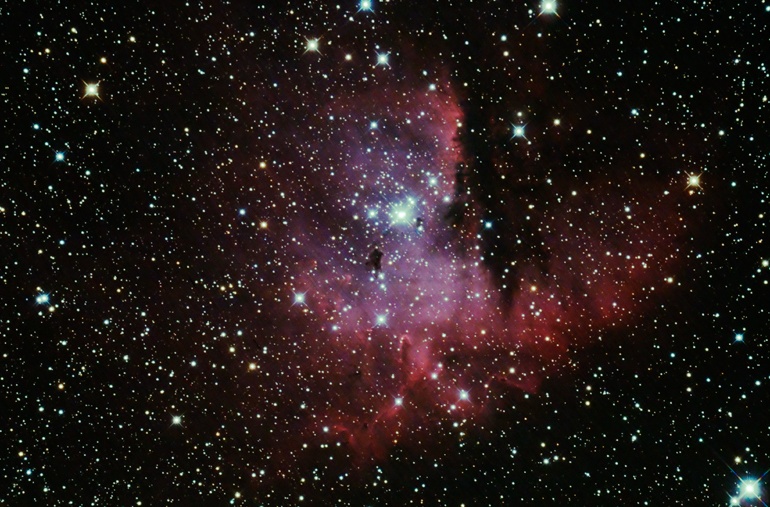
Pac-Man Nebula, in Cassiopeia
October 2010
About NGC 281
The emission nebula NGC281 (PacMan nebula) is located in the constellation Cassiopeia and is associated with the open star cluster IC1590. It is located in the Perseus Spiral Arm and lies approximately 9,500 LY from Earth.
October 9, 2010 · 8″ Astro-Tech RC, f/8 · Canon Digital Rebel 500D / Modified (Hutech) · 200 Minutes / 20x600s @ 800ASA · Orion StarShoot AutoGuider · Skyhawk Observatory, West Bend, WI · Photo by Rick Kazmierski
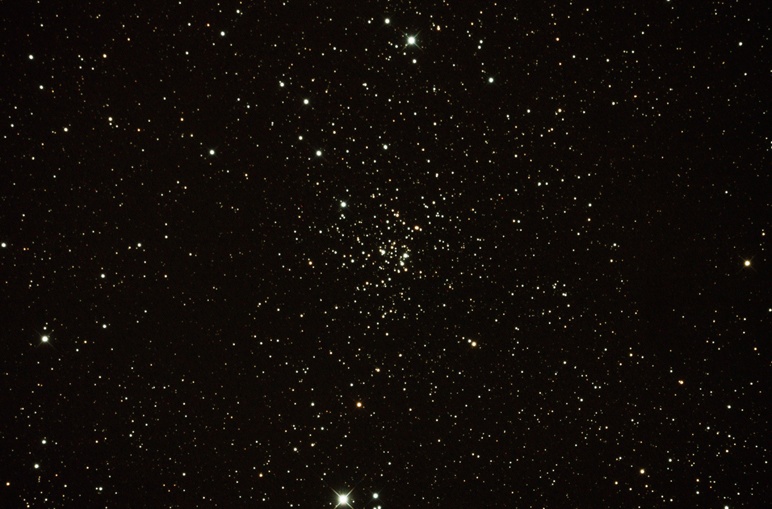
Open star cluster in Cassiopeia
November 2010
About NGC 559
NGC 559, an open star cluster in Cassiopeia.
November 5, 2010 · 8″ Astro-Tech RC, f/8 · Canon Digital Rebel 500D / Modified (Hutech) · 65 Minutes / 13x300s @ 800ASA · Orion StarShoot AutoGuider · Skyhawk Observatory, West Bend, WI · Photo by Rick Kazmierski
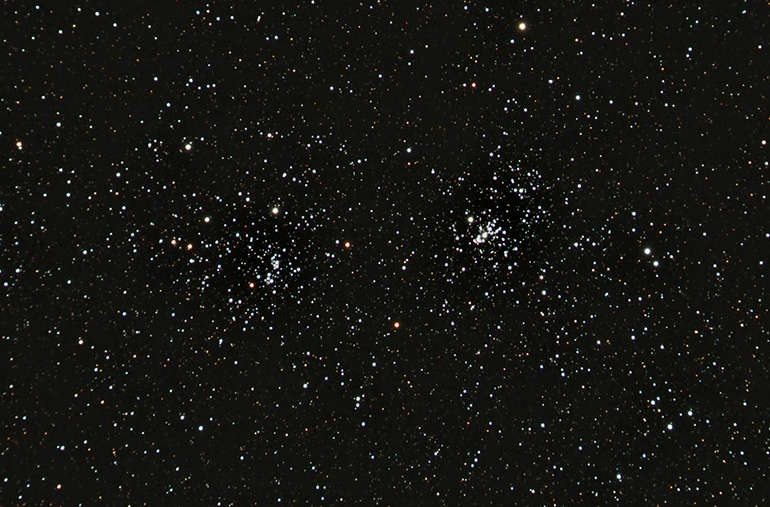
Perseus Double Cluster
October 2006
About NGC 869 & NGC 884
The Perseus Double Cluster (NGC884 and NGC869) is an easy naked eye object and appears as a little cloud in a dark sky. It resolves into a multitude of stars, even in a modest telescope. Found in the constellation of Perseus, these two clusters are 7,000 LY from Earth. They are separated by several hundred light years and are just over 3 million years old.
October 14, 2006 · Orion 80mm f/7.5 Apo Refractor – Baader IR Filter · Canon Digital Rebel 300D / Modified (Hap Griffin) · 20 Minutes / 10x120s @ 800ASA · Manually guided on a 14″ Meade LX200 · Skyhawk Observatory, West Bend, WI · Photo by Rick Kazmierski
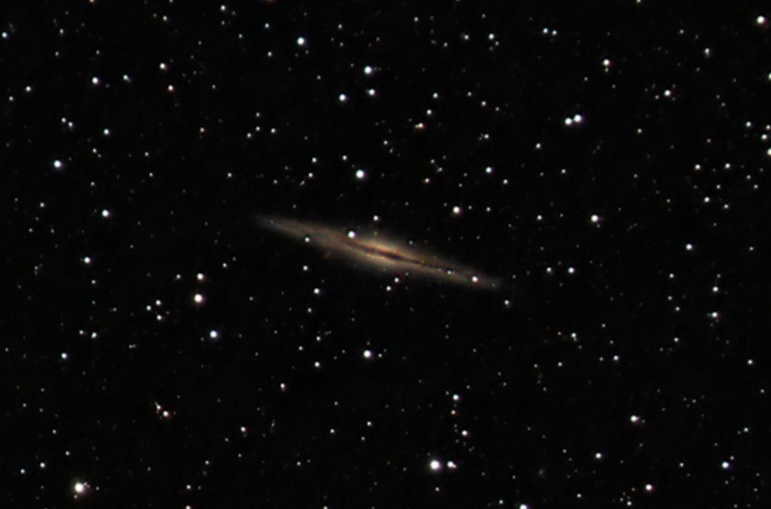
Edge-on spiral galaxy with a dark dust lane
November 2006
About NGC 891
Spiral galaxy NGC 891 is located in the constellation of Andromeda at a distance of 10 million LY from Earth. It is an edge-on spiral from our perspective and displays a prominent central dark band of gas and dust. It is believed to be a member of a small group of galaxies known as the NGC 1023 Group.
November 19, 2006 · Orion 80mm f/7.5 Apo Refractor – Baader IR Filter · Canon Digital Rebel 300D / Modified (Hap Griffin) · 75 Minutes / 15x300s @ 800ASA · Manually guided on a 14″ Meade LX200 · Skyhawk Observatory, West Bend, WI · Photo by Rick Kazmierski
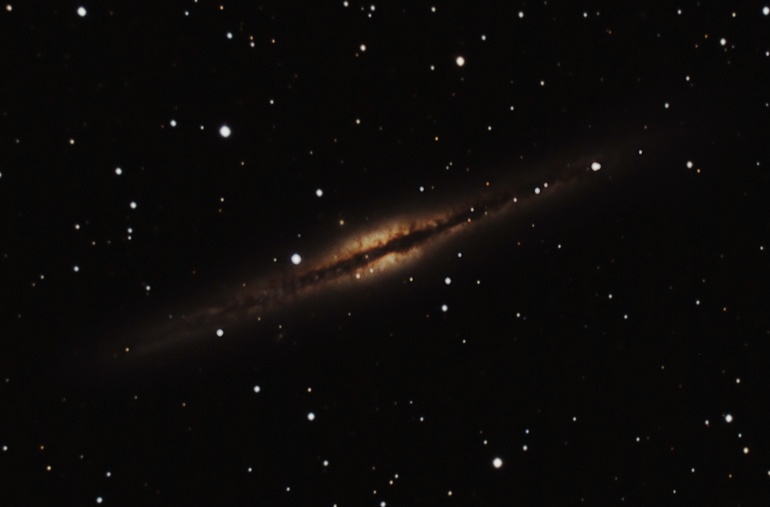
Edge-on spiral galaxy with a dark dust lane
September 2009
About NGC 891
Spiral galaxy NGC 891 is located in the constellation of Andromeda at a distance of 10 million LY from Earth. It is an edge-on spiral from our perspective and displays a prominent central dark band of gas and dust. It is believed to be a member of a small group of galaxies known as the NGC 1023 Group.
September 26, 2009 · 14″ Meade LX200 f/6.3 · Canon Digital Rebel 500D / Modified (Hutech) · 95 Minutes / 19x300s @ 800ASA · Orion StarShoot AutoGuider · Skyhawk Observatory, West Bend, WI · Photo by Rick Kazmierski
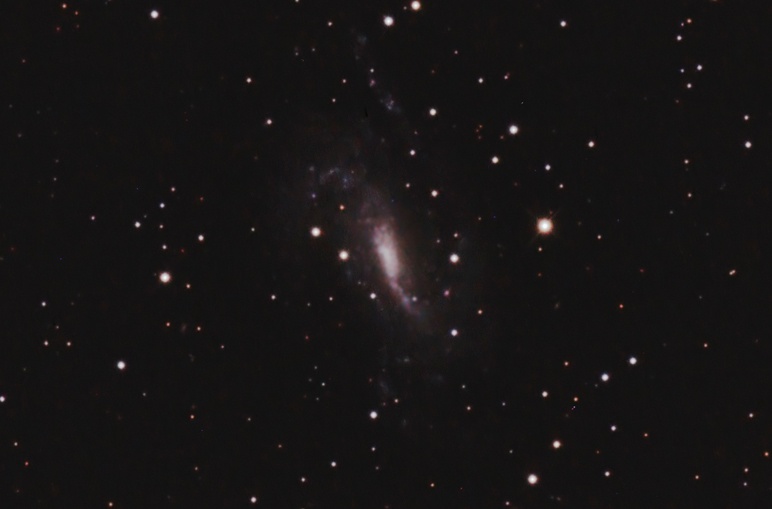
Barred spiral galaxy in Triangulum
December 2010
About NGC 925
NGC925 is a barred spiral in the constellation Triangulum, about 45 million LY away.
December 7, 2010 · 8″ Astro-Tech RC, f/8 · Canon Digital Rebel 500D / Modified (Hutech) · 130 Minutes / 13x600s @ 800ASA · Orion StarShoot AutoGuider · Skyhawk Observatory, West Bend, WI · Photo by Rick Kazmierski

California Nebula, in Perseus
March 2021
About NGC 1499
The California Nebula (NGC1499) has a shape which resembles the outline of the State of California. It is located in the constellation of Perseus at a distance of 1,500 LY from the Earth and extends 100 LY on its long axis. A stellar nursery, NGC1499 shines when the hot young stars within ionize the surrounding Hydrogen gas, causing it to emit light.
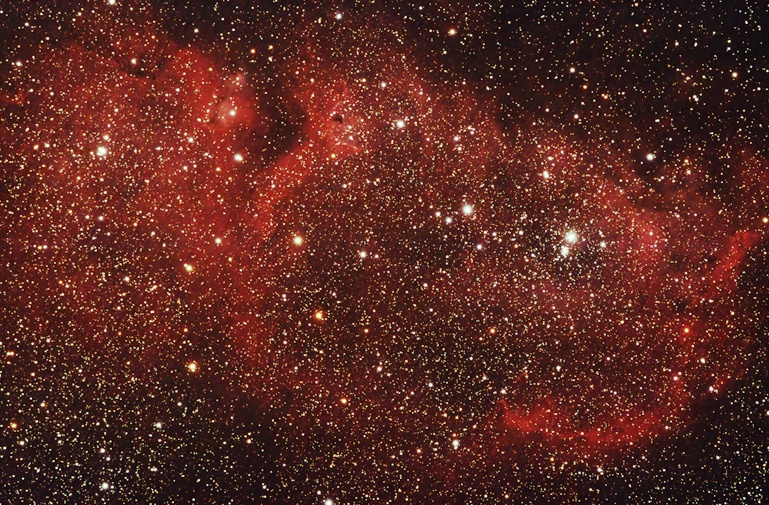
Soul Nebula, in Cassiopeia
2009
About NGC 1848
NGC1848 is one of two bright emission nebulae in the constellation Cassiopeia. Dubbed the Soul Nebula because of its unique shape, NGC1848 lies about 6,000 LY from Earth and shines bright in energized hydrogen fueled by young open clusters in the vicinity.
2009 · WO 105mm f/7 Apo Refractor – AT Field Flattener · Canon Digital Rebel XTi / Modified (Hap Griffin) · 150 Minutes / 30x300s @ 1600ASA · Orion StarShoot AutoGuider · Skyhawk Observatory, West Bend, WI · Photo by Rick Kazmierski

Running Man Nebula, in Orion
December 2010
About NGC 1977
The Running Man Nebula (NGC1977) is a bright reflection cloud within the Orion Nebula. Reflection nebulae are caused by light from hot young stars reflecting off a dense gas and dust cloud positioned behind them. Reflection nebulae shine in blue light because blue light scatters more effectively than longer wave lengths of the light spectrum.
December 28, 2010 · 8″ Astro-Tech RC, f/8 · Canon Digital Rebel 500D / Modified (Hutech) · 120 Minutes / 12x600s @ 800ASA · Orion StarShoot AutoGuider · Skyhawk Observatory, West Bend, WI · Photo by Rick Kazmierski

Flame Nebula, in Orion
November 2006
About NGC 2024
The Flame Nebula is part of a much larger Hydrogen cloud of star forming material known as the Orion Molecular Cloud Complex. It shines due to the ionization of the Hydrogen gas that resides there, a process fueled by the bright star Alnitak seen in the photo to the upper left. The famous dark molecular cloud known as the Horsehead Nebula or Barnard 33, is seen in the upper right. Found in the constellation of Orion, this region lies approximately 1,500 LY from Earth.
November 22, 2006 · Orion 80mm f/7.5 Apo Refractor – Baader IR Filter · Canon Digital Rebel 300D / Modified (Hap Griffin) · 30 Minutes / 10x180s @ 800ASA · Manually guided on a 14″ Meade LX200 · Skyhawk Observatory, West Bend, WI · Photo by Rick Kazmierski

Flame Nebula, in Orion
February 2022
About NGC 2024
The Flame Nebula is part of a much larger Hydrogen cloud of star forming material known as the Orion Molecular Cloud Complex. It shines due to the ionization of the Hydrogen gas that resides there, a process fueled by the bright star Alnitak. Found in the constellation of Orion, this region lies approximately 1,500 LY from Earth.
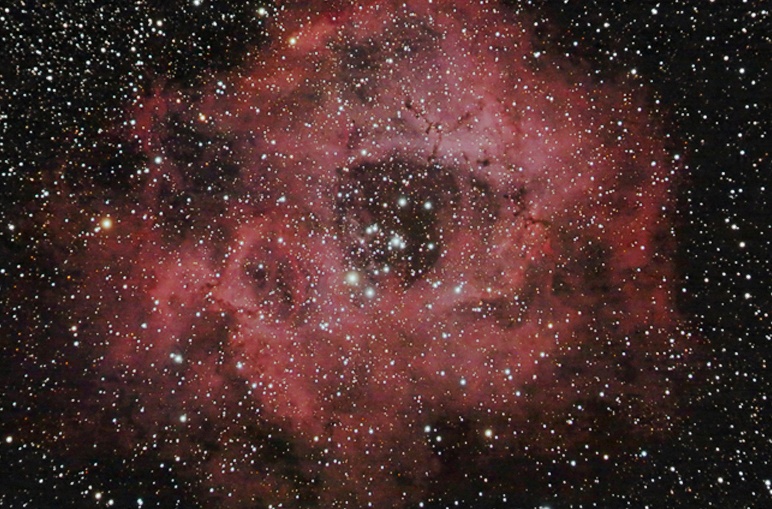
Star cluster inside the Rosette Nebula
December 2006
About NGC 2244
The Rosette is a diffuse nebula of active star formation in the constellation Monoceros. It shines due to the ionization of the Hydrogen gas that resides there, a process fueled by the young energetic stars contained in the open cluster NGC 2244, seen in the center of the above image.
December 18, 2006 · WO ZS 105mm f/7 Apo Refractor – Baader IR Filter · Canon Digital Rebel 300D / Modified (Hap Griffin) · 100 Minutes / 20x300s @ 800ASA · Manually guided on a 14″ Meade LX200 · Skyhawk Observatory, West Bend, WI · Photo by Rick Kazmierski

Cone Nebula region, in Monoceros
February 2022
About NGC 2264
The Cone Nebula is a dark nebula found in the constellation Monoceros. It is formed by a dark cloud of gas and dust which blocks the bright nebula which it silhouettes. The open cluster NGC 2264 (Christmas Tree Cluster) is a young star cluster formed from the surrounding diffuse nebula.
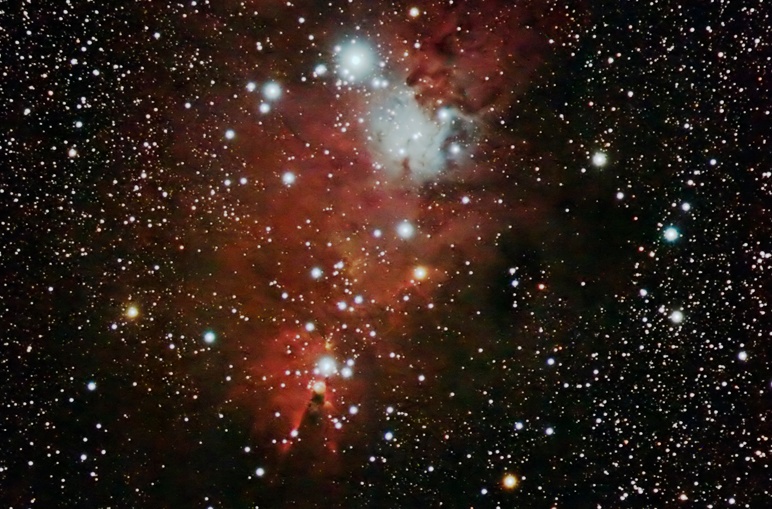
Christmas Tree Cluster and Cone Nebula
2008
About NGC 2264
The Cone Nebula is a dark nebula found in the constellation Monoceros. It is formed by a dark cloud of gas and dust which blocks the bright nebula which it silhouettes. The open cluster NGC 2264 (Christmas Tree Cluster) is a young star cluster formed from the surrounding diffuse nebula.
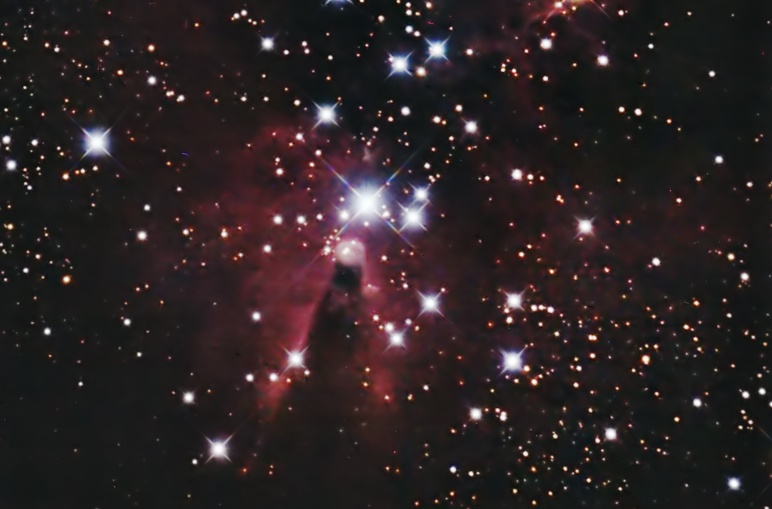
Close-up of the Cone Nebula
February 2011
About NGC 2264
The Cone Nebula is a dark nebula found in the constellation Monoceros. It is formed by a dark cloud of gas and dust which blocks the bright nebula which it silhouettes.
February 2, 2011 · 8″ Astro-Tech RC, f/8 · Canon Digital Rebel 500D / Modified (Hutech) · 140 Minutes / 14x600s @ 800ASA · Orion StarShoot AutoGuider · Skyhawk Observatory, West Bend, WI · Photo by Rick Kazmierski
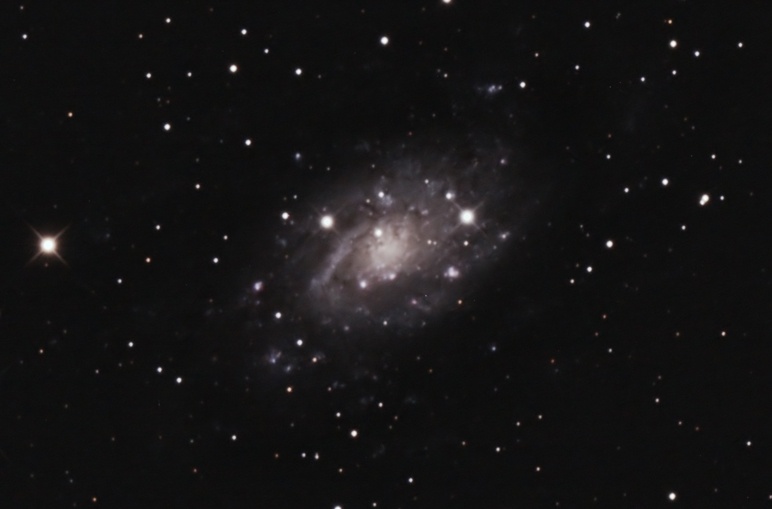
Spiral galaxy in Camelopardalis
January 2011
About NGC 2403
NGC2403 is a spiral galaxy in the constellation Camelopardalis. An outlying member of the M81 Group, it is a distance of 12 million LY from Earth.
January 8, 2011 · 8″ Astro-Tech RC, f/8 · Canon Digital Rebel 500D / Modified (Hutech) · 140 Minutes / 14x600s @ 800ASA · Orion StarShoot AutoGuider · Skyhawk Observatory, West Bend, WI · Photo by Rick Kazmierski
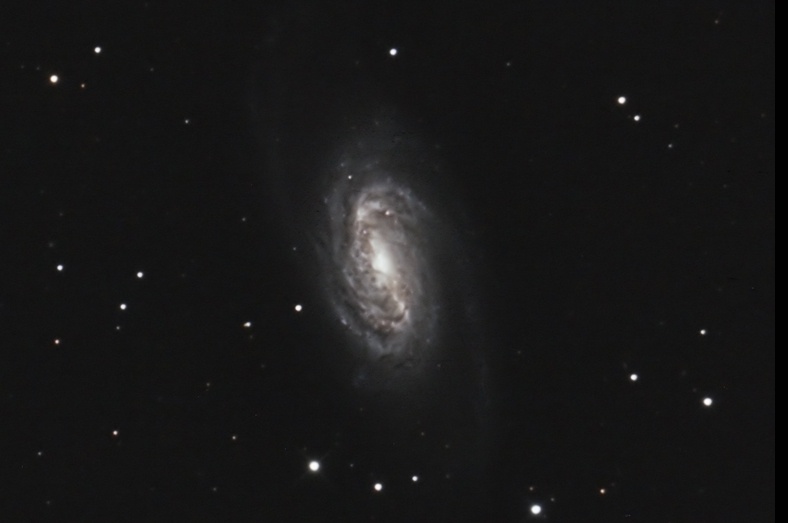
Barred spiral galaxy in Leo
January 2011
About NGC 2903
NGC 2903 is a beautiful spiral galaxy located in the constellation of Leo, seen nearly face-on from our perspective. It is estimated to be 30 million LY distant. NGC 2905 is a large bright star cloud within the galaxy.
January 4, 2011 · 8″ Astro-Tech RC, f/8 · Canon Digital Rebel 500D / Modified (Hutech) · 120 Minutes / 12x600s @ 800ASA · Orion StarShoot AutoGuider · Skyhawk Observatory, West Bend, WI · Photo by Rick Kazmierski
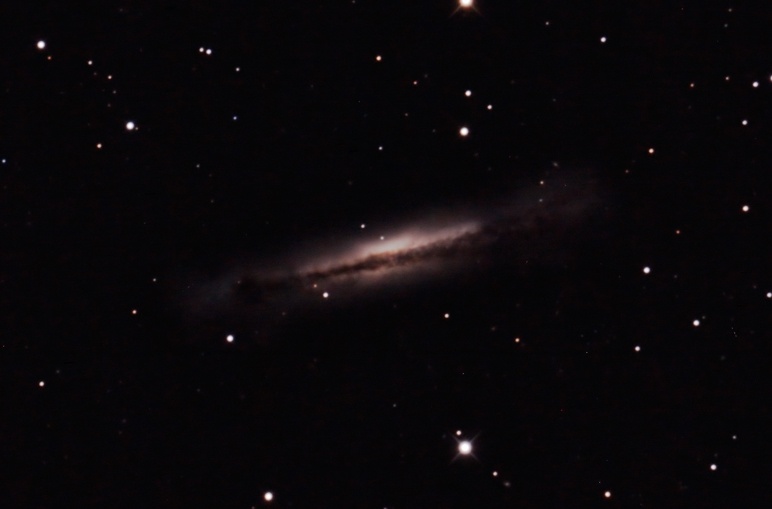
Hamburger Galaxy, in Leo
December 2010
About NGC 3628
NGC 3628 is one of three members in the Leo Triplet, which also includes M65 and M66. An edge-on galaxy with a wide equatorial band of gas and dust with ends distorted into a fan shape, possibly by gravitational influences from its two neighbors. It is seen in the constellation of Leo and is estimated to be 35 million LY distant.
December 12, 2010 · 8″ Astro-Tech RC, f/8 · Canon Digital Rebel 500D / Modified (Hutech) · 160 Minutes / 16x600s @ 800ASA · Orion StarShoot AutoGuider · Skyhawk Observatory, West Bend, WI · Photo by Rick Kazmierski
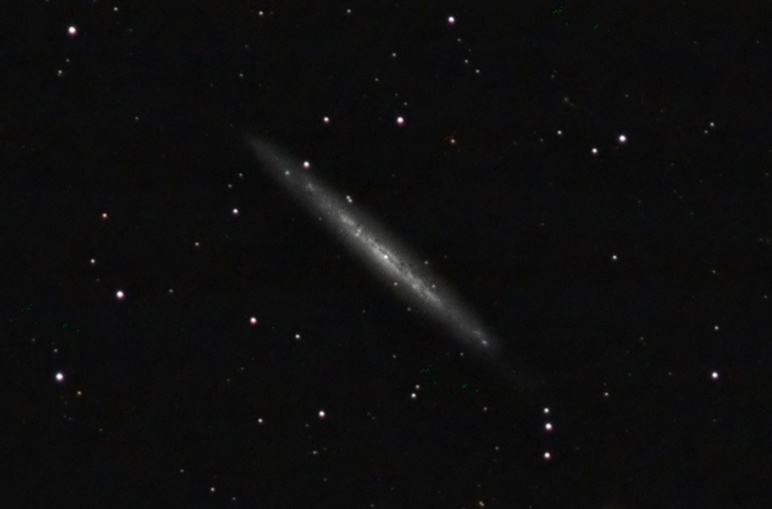
Silver Needle Galaxy, in Canes Venatici
March 2007
About NGC 4244
NGC 4244 is an edge-on spiral galaxy located in the constellation of Canes Venatici. Its estimated distance from Earth is 15 million LY.
March 2007 · WO ZS 105mm f/7 Apo Refractor – Baader IR Filter · Canon Digital Rebel 300D / Modified (Hap Griffin) · 105 Minutes / 21x300s @ 800ASA · Manually guided on a 14″ Meade LX200 · Skyhawk Observatory, West Bend, WI · Photo by Rick Kazmierski
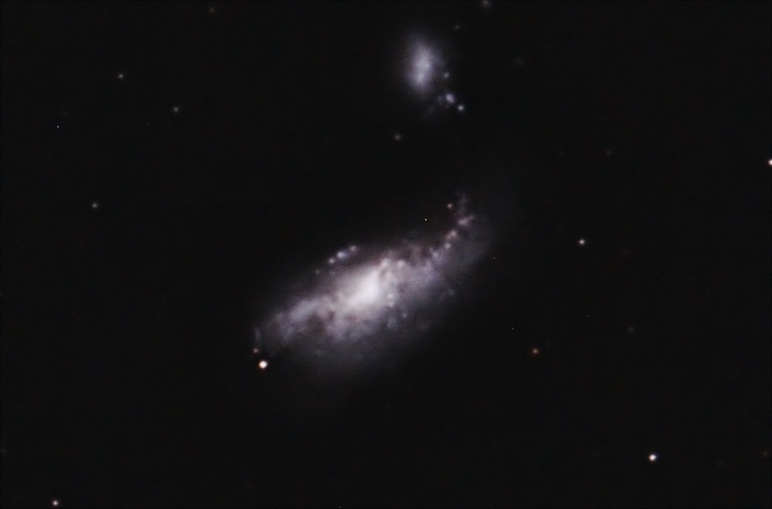
Cocoon Galaxy, with its small companion NGC 4485
February 2011
About NGC 4490
NGC 4490 is a pair of interacting galaxies that lie in the constellation of Canes Venatici. These two galaxies have caused significant gravitational disturbances in each other and a trail of stars stretches between them. They are 25,000 LY apart and separating, having already reached their closest encounter. Also known as the Cocoon Galaxy, NGC 4490 is an estimated distance of 45 million LY from Earth.
February 2, 2011 · 8″ Astro-Tech RC, f/8 · Canon Digital Rebel 500D / Modified (Hutech) · 80 Minutes / 8x600s @ 800ASA · Orion StarShoot AutoGuider · Skyhawk Observatory, West Bend, WI · Photo by Rick Kazmierski
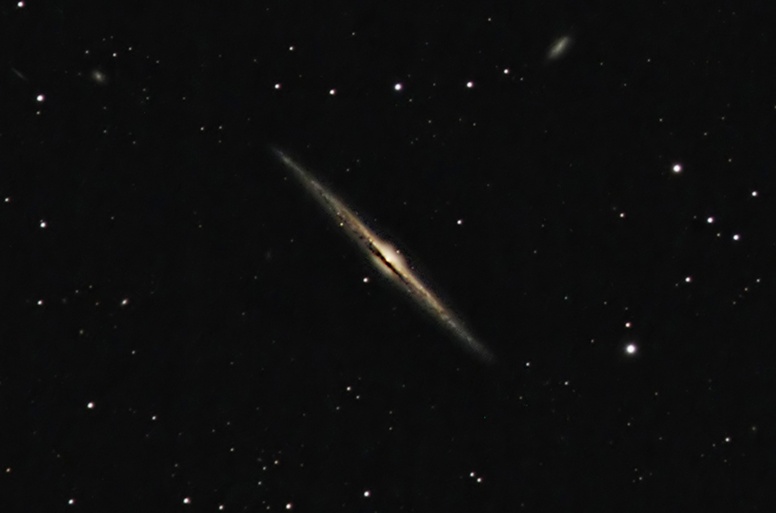
Needle Galaxy, in Coma Berenices
April 2007
About NGC 4565
Located in Coma Berenices nearly 31 million LY from Earth, NGC 4565 is a Spiral Galaxy viewed edge on. Its central bulge can be easily seen surrounded by the obscuring gas and dust of its spiral arms. Several small companion galaxies are also visible in the image.
April 9, 2007 · WO ZS 105mm f/7 Apo Refractor – Baader IR Filter · Canon Digital Rebel 300D / Modified (Hap Griffin) · 120 Minutes / 24x300s @ 800ASA · Manually guided on a 14″ Meade LX200 · Skyhawk Observatory, West Bend, WI · Photo by Rick Kazmierski
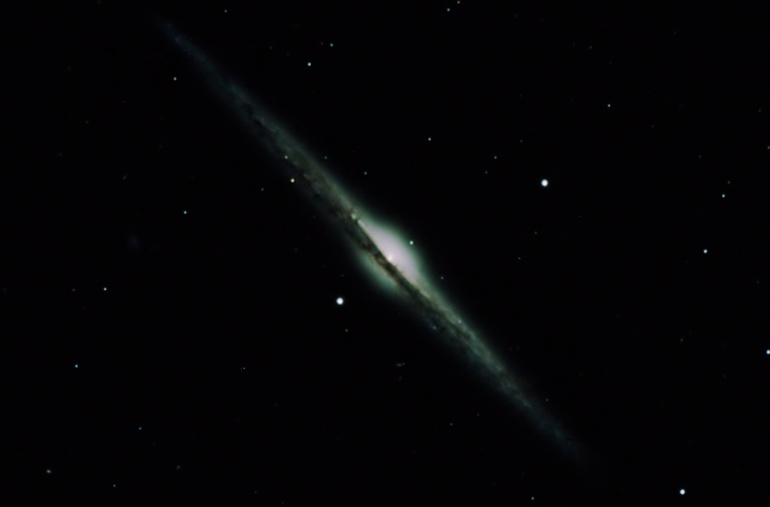
Needle Galaxy, in Coma Berenices
April 2010
About NGC 4565
Located in Coma Berenices nearly 31 million LY from Earth, NGC 4565 is a Spiral Galaxy viewed edge on. Its central bulge can be easily seen surrounded by the obscuring gas and dust of its spiral arms. Several small companion galaxies are also visible in the image.
April 8, 2010 · Astro-Tech 8″ RC · Canon Digital Rebel 500D / Modified (Hutech) · 120 Minutes / 24x300s @ 800ASA · Orion StarShoot AutoGuider · Skyhawk Observatory, West Bend, WI · Photo by Rick Kazmierski
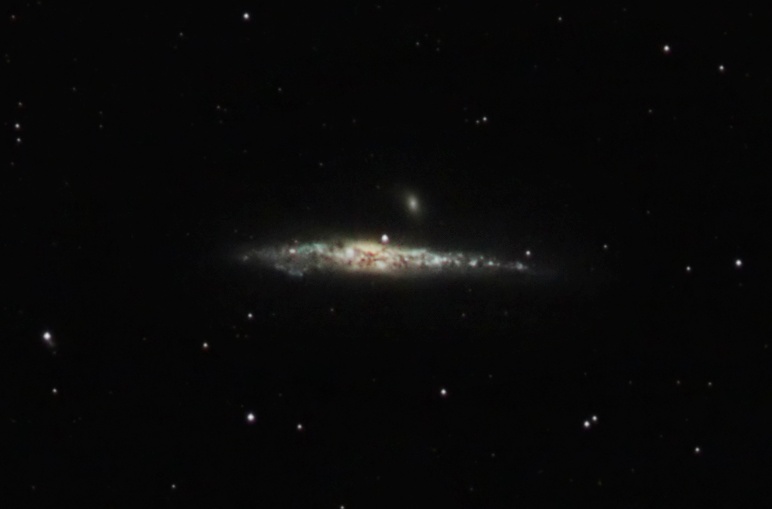
Whale Galaxy, in Canes Venatici
2007
About NGC 4631
NGC 4631 is a large distorted spiral galaxy in the constellation Canes Venatici. Its odd shape is due to interaction with its companion NGC 4627. This object is estimated to be 25 million LY distant and has played a significant role in distorting neighboring galaxy NGC 4656, out of the field of view to the lower left. All three companions have been involved in close encounters with each other in the past.
Spiral galaxy in Coma Berenices (small copy only)
May 2010
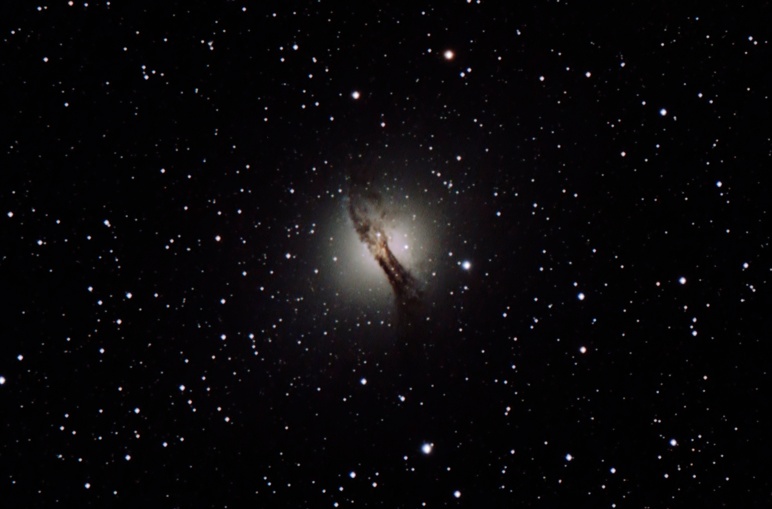
Centaurus A, a galaxy crossed by a dark dust band
February 2010
About NGC 5128
NGC5128 is an intermediate type of galaxy between elliptical and spiral. It is the closest radio galaxy to the Earth, lying 11 million LY away in the constellation Centaurus. It is believed to be devouring a spiral galaxy, giving it its unique appearance. It is also believed to be hiding a super massive blackhole.
February 11, 2010 · WO ZS 105mm f/7 Apo Refractor · Canon Digital Rebel 500D / Modified (Hutech) · 95 Minutes / 19x300s @ 800ASA · Orion StarShoot AutoGuider · Winter Star Party, Florida Keys · Photo by Rick Kazmierski
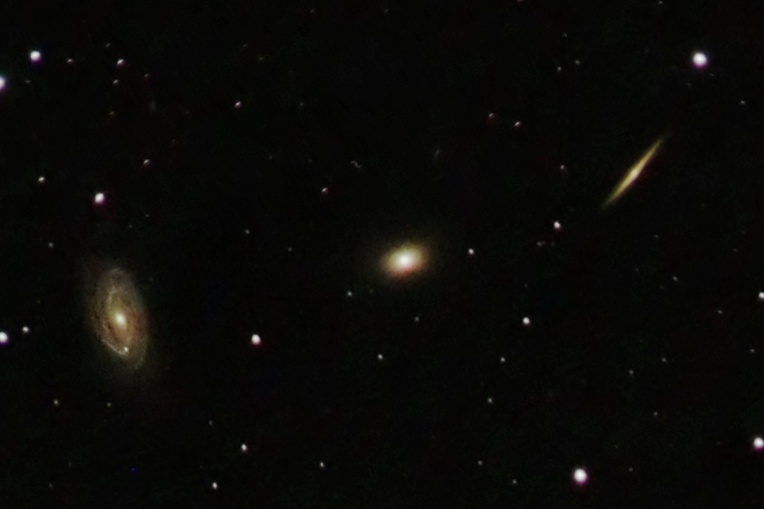
Draco Trio, three galaxies side by side in Draco
April 2007
About NGC 5981, 5982 & 5985
This exciting trio of galaxies are gravitationally bound and are an estimated 100 million LY from Earth! They represent three distinct types of galaxies; NGC5985 is a barred spiral (left), NGC5982 is an elliptical galaxy (center), and NGC5981 is an edge-on spiral galaxy (right). They are located in the constellation of Draco.
April 20, 2007 · WO ZS 105mm f/7 Apo Refractor – Baader IR Filter · Canon Digital Rebel 300D / Modified (Hap Griffin) · 100 Minutes / 20x300s @ 800ASA · Manually guided on a 14″ Meade LX200 · Skyhawk Observatory, West Bend, WI · Photo by Rick Kazmierski
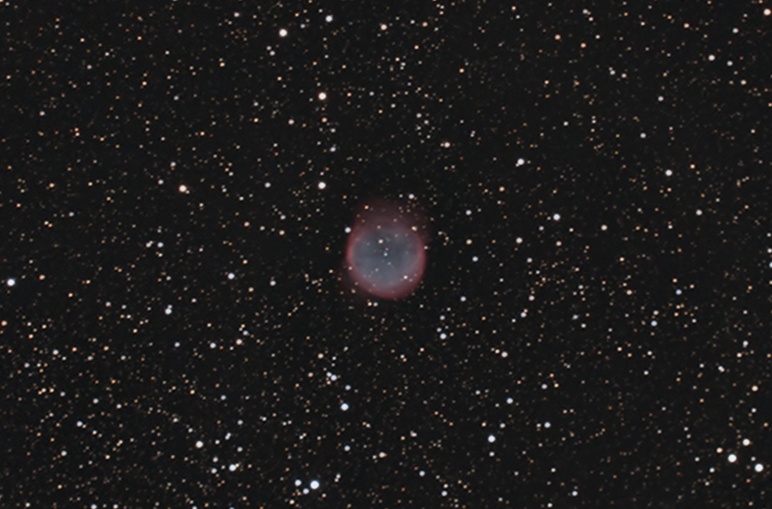
Planetary nebula in Aquila
September 2013
About NGC 6781
Planetary Nebula in the constellation Aquila.
September 25, 2013 · 14″ LX200 f/6.3 · Canon Digital Rebel 500D / Modified (Hutech) · 128 Minutes / 32x240s @ 800ASA · Orion StarShoot AutoGuider · Skyhawk Observatory, West Bend, WI · Photo by Rick Kazmierski
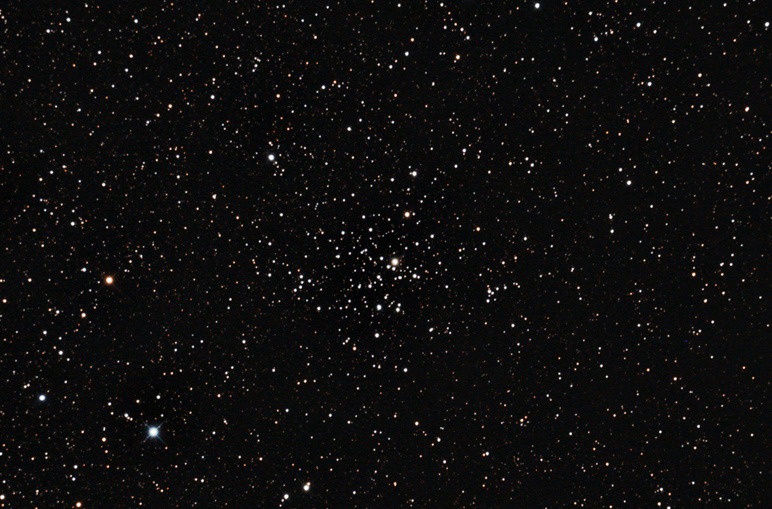
Open star cluster in Vulpecula
August 2010
About NGC 6834
NGC6834 is a poorly studied open cluster in the constellation Cygnus. It is an estimated 6,700 LY distant and 80 million years old.
August 28, 2010 · 8″ Astro-Tech RC, f/8 · Canon Digital Rebel 500D / Modified (Hutech) · 60 Minutes / 15x240s @ 800ASA · Orion StarShoot AutoGuider · Skyhawk Observatory, West Bend, WI · Photo by Rick Kazmierski
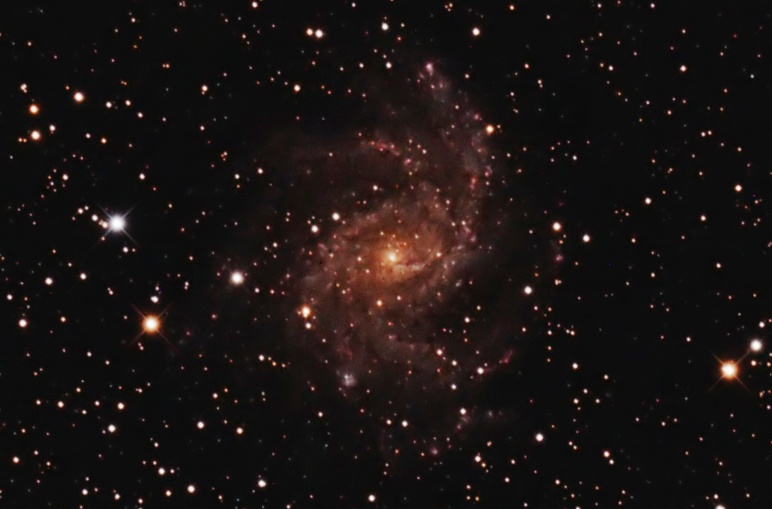
Fireworks Galaxy
September 2010
About NGC 6946
NGC6946 is a face-on Spiral Galaxy in the constellation Cepheus. It is 22.5 million LY distant with an apparent magnitude of 9.6 and apparent dimensions of 11.5 x 9.8 arcmin. In the past century over 9 supernovae have been observed in its spiral arms, making it the most prolific known galaxy for such phenomenon.

Supernova remnant in Cygnus
October 2020
About Veil Nebula
NGC6995 is the eastern portion of the Cygnus Loop and is located in the constellation Cygnus at a distance of 2,500 LY. The loop includes the Eastern Veil, the Western Veil, and Pickering’s Triangular Wisp. It is a large, relatively faint supernova remnant which exploded around 15,000 years ago.

Western Veil Nebula, in Cygnus
August 2022
About NGC 6960
The western portion of the Veil Nebula (NGC 6960) is located in the constellation of Cygnus at a distance of 2,500 LY. Also known as The Witch’s Broom, this supernova remnant is estimated to be 15,000 years old.

Eastern Veil Nebula, in Cygnus
August 2022
About NGC 6992
NGC6995 is the eastern portion of the Cygnus Loop and is located in the constellation Cygnus at a distance of 2,500 LY. The loop includes the Eastern Veil, the Western Veil, and Pickering’s Triangular Wisp. It is a large, relatively faint supernova remnant which exploded around 15,000 years ago.
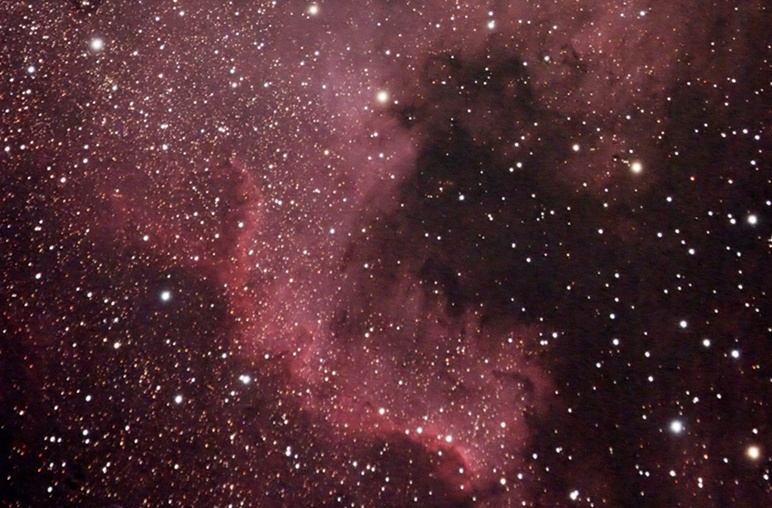
North America Nebula, in Cygnus
September 2006
About NGC 7000
The North American Nebula (NGC 7000) is located in the constellation of Cygnus at a distance of 2,000 LY. The southern half of the nebula is captured in the above image. NGC 7000 is part of a large star forming region in Cygnus and shines due to the ionization of the surrounding Hydrogen gas and dust; a process fueled by nearby young hot stars.
September 25, 2006 · Orion 80mm f/7.5 Apo Refractor – Baader IR Filter · Canon Digital Rebel 300D / Modified (Hap Griffin) · 60 Minutes / 12x300s @ 800ASA · Manually guided on a 14″ Meade LX200 · Skyhawk Observatory, West Bend, WI · Photo by Rick Kazmierski
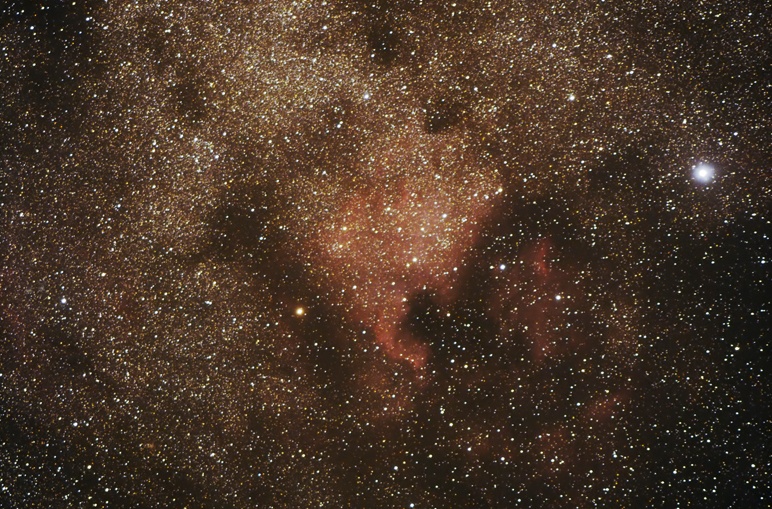
North America Nebula, wide-field view
August 2010
About NGC 7000
The North American Nebula (NGC 7000) is located in the constellation of Cygnus at a distance of 2,000 LY. NGC 7000 is part of a large star forming region in Cygnus and shines due to the ionization of the surrounding Hydrogen gas and dust; a process fueled by nearby young hot stars.
August 6, 2010 · 100mm Lens · Canon Digital Rebel 500D / Modified (Hutech) · 30 Minutes / 10x180s @ 400ASA · Orion StarShoot AutoGuider · Skyhawk Observatory, West Bend, WI · Photo by Rick Kazmierski
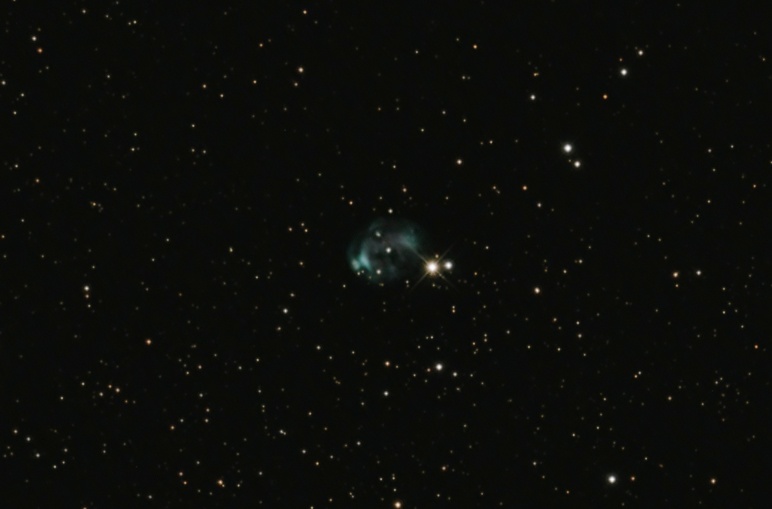
Fetus Nebula, a planetary nebula in Cygnus
August 2010
About NGC 7008
NGC7008 is a planetary nebula in the constellation Cygnus, located 2,800 LY distant.
August 29, 2010 · 8″ Astro-Tech RC, f/8 · Canon Digital Rebel 500D / Modified (Hutech) · 200 Minutes / 40x300s @ 800ASA · Orion StarShoot AutoGuider · Skyhawk Observatory, West Bend, WI · Photo by Rick Kazmierski
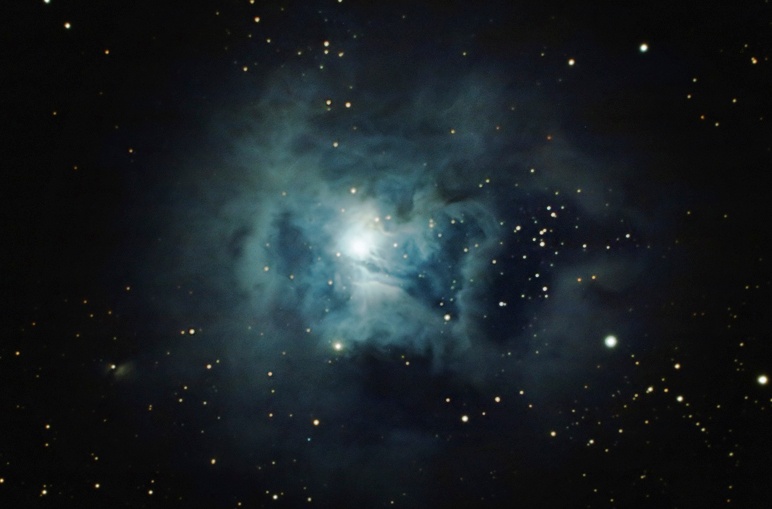
Iris Nebula, in Cepheus
October 2009
About NGC 7023
NGC 7023 is a reflection nebula in the constellation Cepheus. It shines by the reflected light of the bright star SAO129123. It hides a young star cluster within and lies 1,300 LY distant.
October 10, 2009 · 14″ Meade LX200 f/6.3 · Canon Digital Rebel 500D / Modified (Hutech) · 120 Minutes / 24x300s @ 800ASA · Orion StarShoot AutoGuider · Skyhawk Observatory, West Bend, WI · Photo by Rick Kazmierski
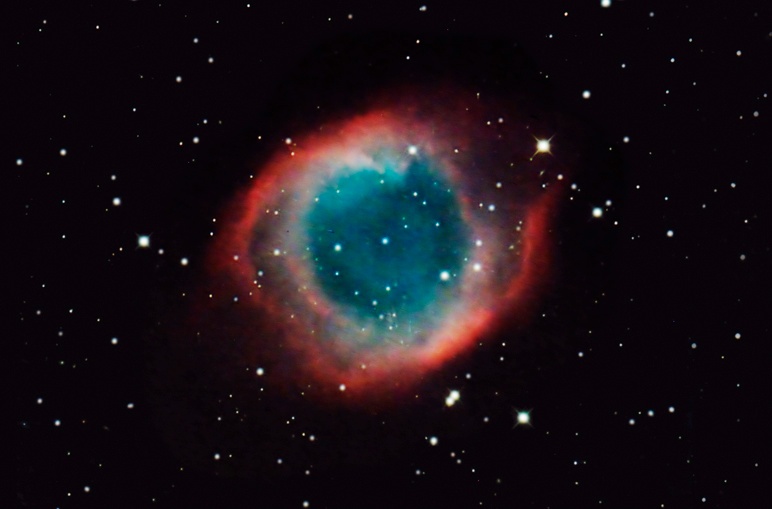
Helix Nebula, in Aquarius
September 2010
About NGC 7293
Planetary Nebula NGC 7293 (Helix Nebula) is located in the constellation of Aquarius at a distance of 650 LY from Earth. The central star which generated this nebula and causes it to shine is a hot white dwarf. A similar end awaits our sun in about 5 billion years when it uses up all its nuclear fuel and in the process, sheds its outer layers into space. During this event, our Earth will be vaporized.
September 2010 · 8″ Astro-Tech RC, f/8 · Canon Digital Rebel 400D / Modified (Hap Griffin) · 250 Minutes / 25x600s @ 800ASA · Orion StarShoot AutoGuider · Skyhawk Observatory, West Bend, WI · Photo by Rick Kazmierski
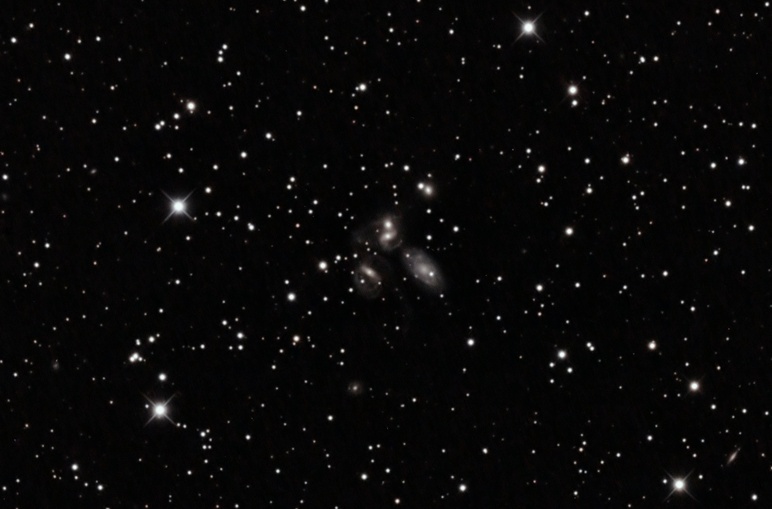
Stephan’s Quintet, a compact group of five galaxies in Pegasus
November 2010
About NGC 7320
Stephan’s Quintet is a group of five galaxies (NGC7317, NGC7318A, NGC7318B, NGC7319, and NGC7320) in the constellation Pegasus. This gravitationally bound galaxy group lies 300 million LY distant! NGC7320 is the bright central spiral, and although visually a member of the Group, it has proven to be significantly closer and a member of the NGC7331 Group.
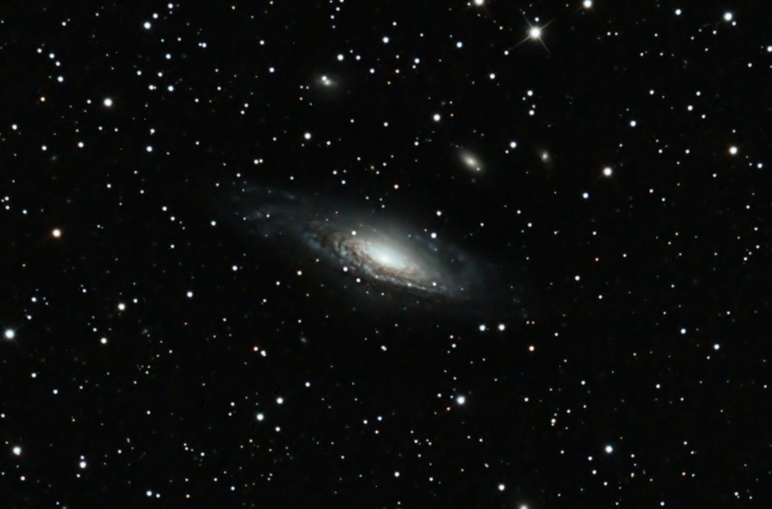
Spiral galaxy in Pegasus with small companion galaxies
October 2010
About NGC 7331
NGC7331 is a spiral galaxy in the constellation Pegasus, 40 million LY distant. Spiral structure is evident, despite its small inclination from the edge-on position. Several companion galaxies are visible.
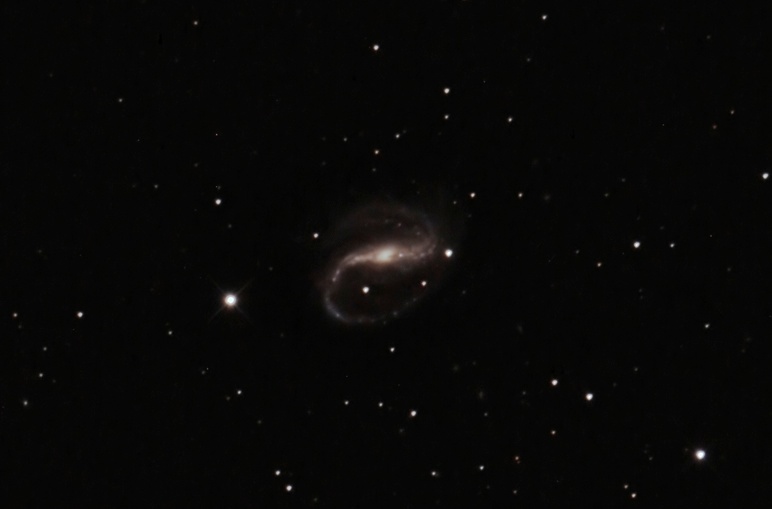
Barred spiral galaxy in Pegasus
November 2010
About NGC 7479
NGC7479 is a barred spiral galaxy about 105 million LY distant in the constellation of Pegasus. It is also known as a Seyfert galaxy undergoing starburst activity in the nucleus and the outer arms. Polarization studies of this galaxy indicate that it recently underwent a minor merger and that it is unique in the radio spectrum, with arms opening in the opposite direction of the optical arms.
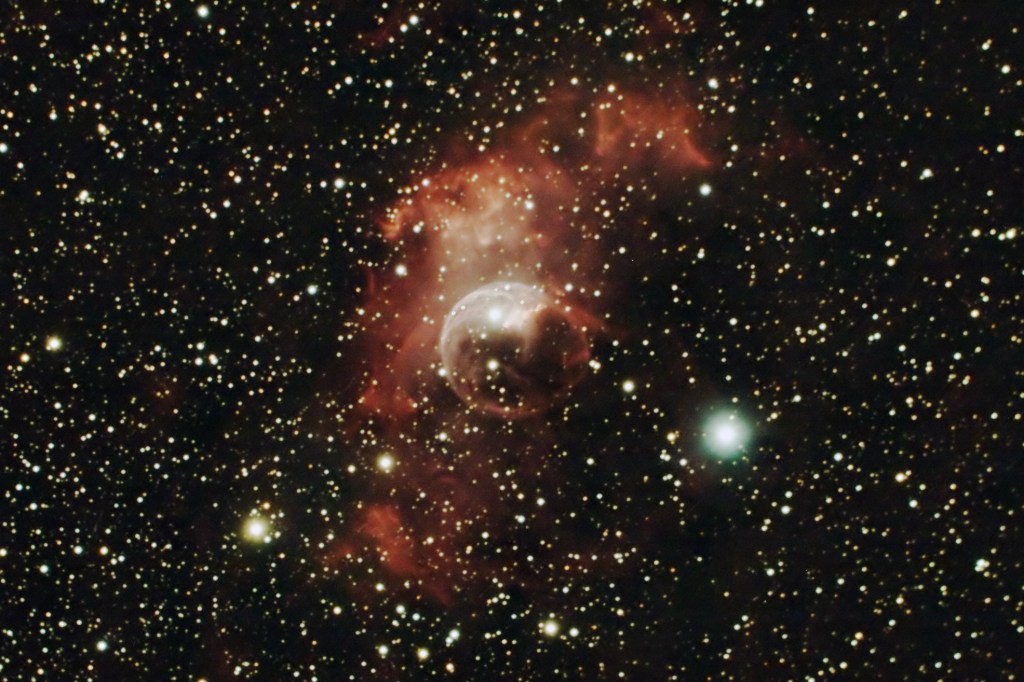
Bubble Nebula, in Cassiopeia
October 2009
About NGC 7635
NGC 7635, also known as the Bubble Nebula, is located in the constellation Cassiopeia. Found amid a rich Hydrogen II region of interstellar gas and dust, the bubble is a mere 10 LY across and created by stellar wind from a massive, young hot central star. Estimates place NGC 7635 at a distance of 11,000 LY.

Caroline’s Rose, an open star cluster in Cassiopeia
September 2022
About NGC 7789
NGC7789 is an open star cluster in the constellation of Cassiopeia. It was discovered by Caroline Herschel and included as an NGC object. Also known as the “White Rose” or “Caroline’s Rose” Cluster because its appearance visually looks like a swirling pattern of rose petals.
IC, Barnard & Other Objects

Flaming Star Nebula, in Auriga
February 2022

Jellyfish Nebula, a supernova remnant in Gemini
January 2020
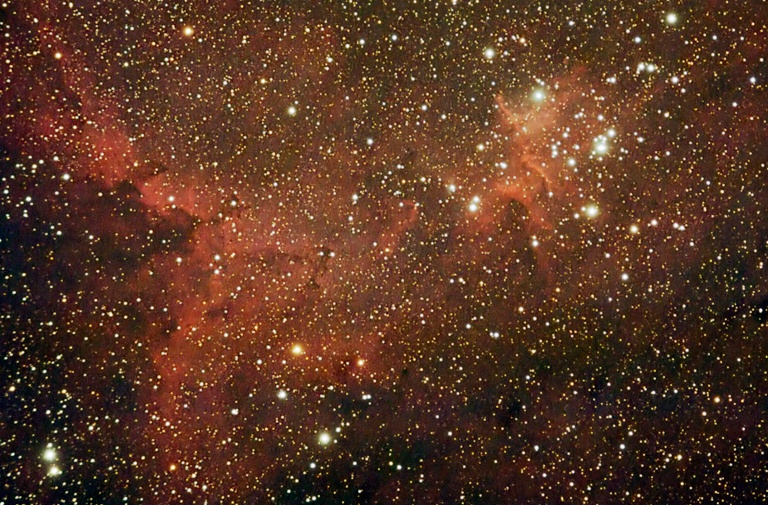
Heart Nebula, in Cassiopeia
October 2008
About IC 1805
The above image is a portion of the large emission nebula IC1805 (Heart Nebula) and resides in the constellation of Cassiopeia. The nebula is a plasma of ionized hydrogen and free electrons driven by the bright star cluster Melotte 15, seen in the upper right of the image. IC1805 lies at a distance of 7,500 LY from Earth.
October 31, 2008 · WO ZS 105mm f/7 Apo Refractor · Canon Digital Rebel 400D / Modified (Hap Griffin) · 180 Minutes / 36x300s @ 800ASA · Manually guided on a 14″ Meade LX200 · Skyhawk Observatory, West Bend, WI · Photo by Rick Kazmierski

Elephant Trunk Nebula, in Cepheus
July 2022
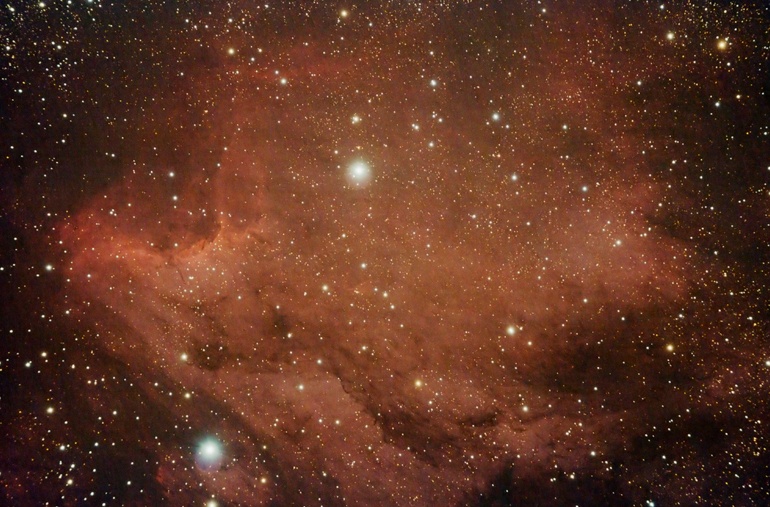
Pelican Nebula, in Cygnus
August 2008
About IC 5067
IC5067 is an emission nebula in the constellation Cygnus and is associated with the North American Nebula. Dubbed the Pelican Nebula because of its distinctive shape, it lies at a distance of 1,800 LY from Earth.
August 30, 2008 · WO ZS 105mm f/7 Apo Refractor · Canon Digital Rebel 400D / Modified (Hap Griffin) · 170 Minutes / 34x300s @ 800ASA · Manually guided on a 14″ Meade LX200 · Skyhawk Observatory, West Bend, WI · Photo by Rick Kazmierski

Pelican Nebula, in Cygnus
June 2022
About IC 5070
IC5067 is an emission nebula in the constellation Cygnus and is associated with the North American Nebula. Dubbed the Pelican Nebula because of its distinctive shape, it lies at a distance of 1,800 LY from Earth.
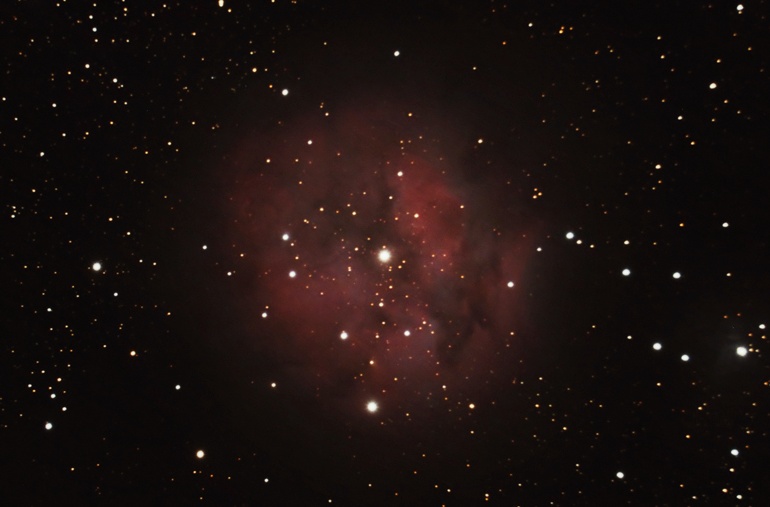
Cocoon Nebula, in Cygnus
September 2009
About IC 5146
The Cocoon Nebula IC5146 is an emission nebula in the constellation Cygnus. It lies at a distance of 4,000 LY from Earth and is 15 LY in diameter. The young central star which fuels the nebula is an estimated 100,000 years old. Dark nebula Barnard 168 surrounds the nebula and extends westward.
September 21, 2009 · Meade 14″ LX200 f/6.3 · Canon Digital Rebel 500D / Modified (Hutech) · 65 Minutes / 13x300s @ 1600ASA · Orion StarShoot AutoGuider · Skyhawk Observatory, West Bend, WI · Photo by Rick Kazmierski
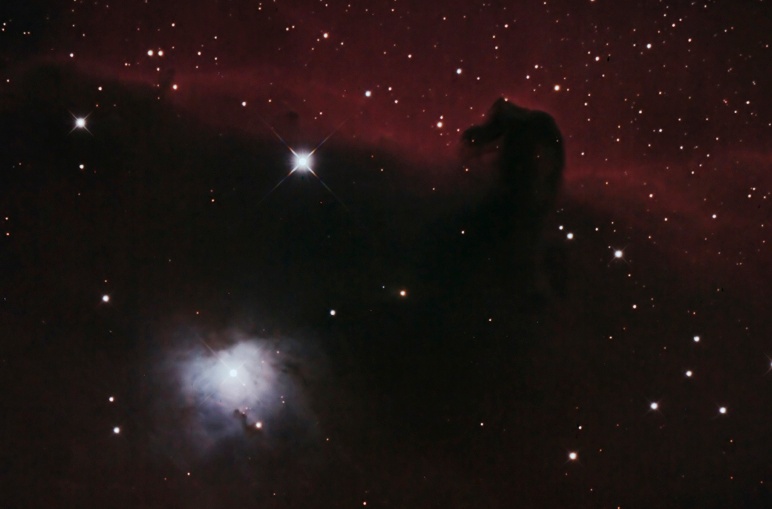
Horsehead Nebula, in Orion
December 2010
About Barnard 33
The Horsehead Nebula (also known as B33 in emission nebula IC434) is a dark nebula in the constellation of Orion. It is located just south of the star Alnitak which is in Orion’s belt, and is part of a much larger Orion Molecular Cloud Complex. At a distance of 1,500 LY, the darkness of the Horsehead is caused mostly by thick dust obscuring the glowing Hydrogen gas behind it.
December 2, 2010 · 8″ Astro-Tech RC, f/8 · Canon Digital Rebel 500D / Modified (Hutech) · 120 Minutes / 12x600s @ 800ASA · Orion StarShoot AutoGuider · Skyhawk Observatory, West Bend, WI · Photo by Rick Kazmierski
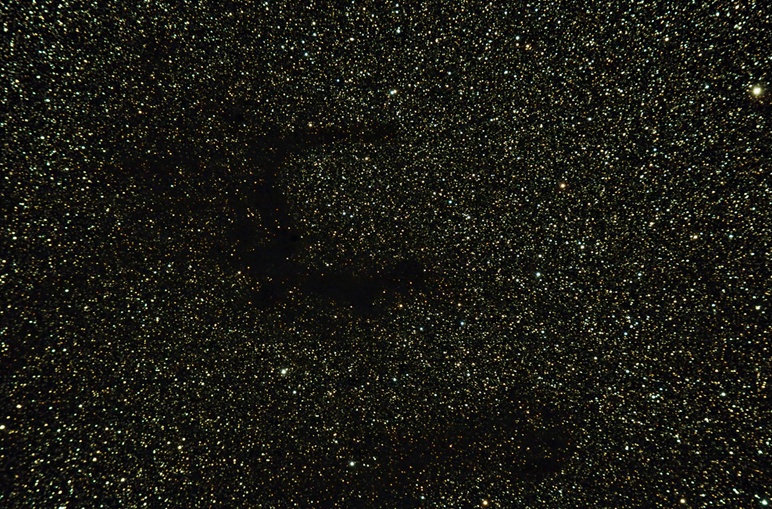
Dark E-shaped dust cloud against the Milky Way in Aquila
October 2008
About Barnard’s E
Barnard’s E is a pair of dark nebulae (B142 & B143) in the constellation Aquila at a distance of 2,000 LY from Earth. It forms a well defined dark area on a rich background of the Milky Way, created by obstructing interstellar gas & dust. Its distinctive shape suggests the letter E.
October 4, 2008 · WO ZS 105mm f/7 Apo Refractor · Canon Digital Rebel 400D / Modified (Hap Griffin) · 60 Minutes / 12x300s @ 800ASA · Manually guided on a 14″ Meade LX200 · Skyhawk Observatory, West Bend, WI · Photo by Rick Kazmierski
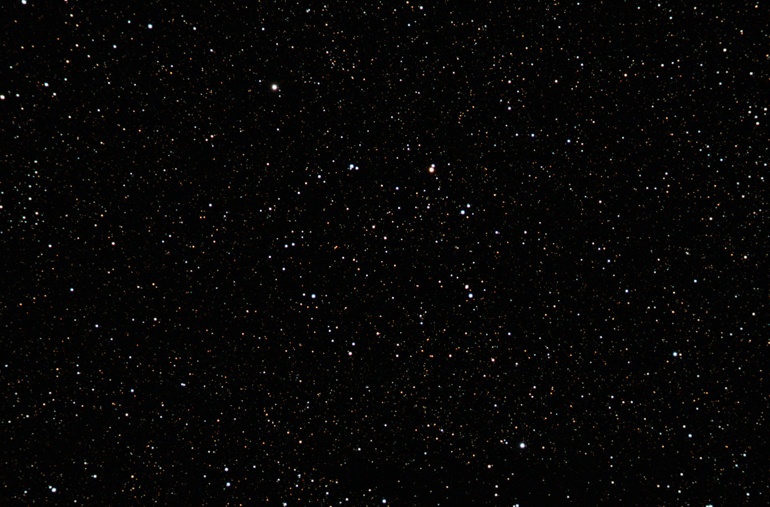
A ring of stars in Cygnus, also called the Dreamcatcher
August 2007
About Fairy Ring
The Fairy Ring is an asterism formed by a ring of (what appear to be) double stars in the constellation Cygnus. Also dubbed the Dreamcatcher, it is a visual grouping of stars with no physical association. Although more obvious visually, it is still a striking object in the above image.
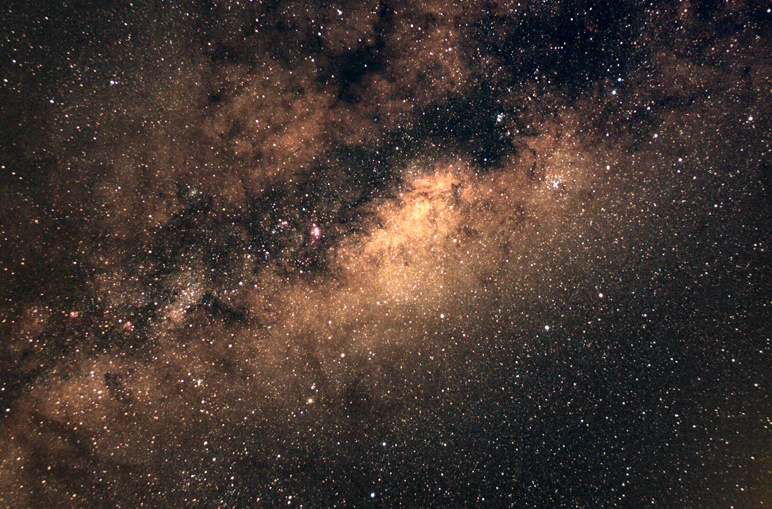
The Sagittarius region, from Abiquiu, New Mexico
May 2008
About Milky Way
This image was taken on a small ranch near Abiquiu, NM. The Sagittarius Region of the Milky Way is rich in star formation, open and globular star clusters, and large star fields. It hosts the center of our galaxy, which is believed to contain a large blackhole. A knowledge of the night sky and a keen eye reveal dozens of deep sky objects in this photo.
May 30, 2008 · 35mm Canon Lens · Canon Digital Rebel 400D / Modified (Hap Griffin) · 21 Minutes / 14x90s @ 800ASA · Manually guided on an Orion Skyview Pro · Abiquiu, New Mexico · Photo by Rick Kazmierski
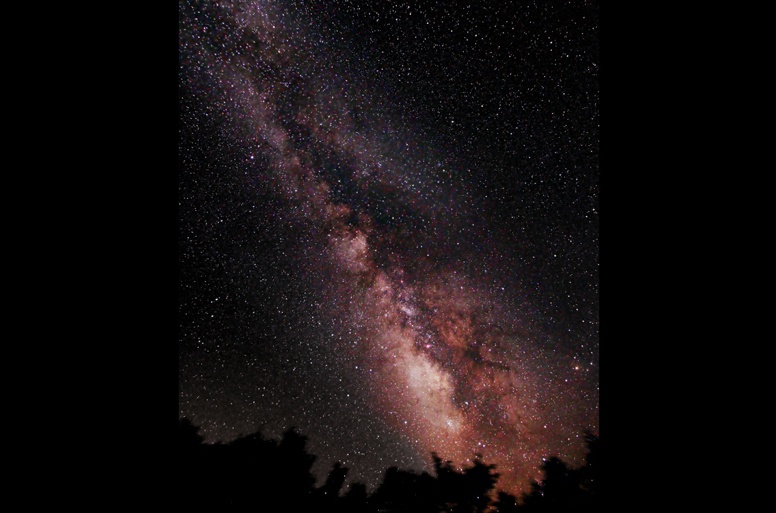
Rising above the treetops in New Mexico
All photographs © Rick Kazmierski unless otherwise credited. You’re welcome to share them.

